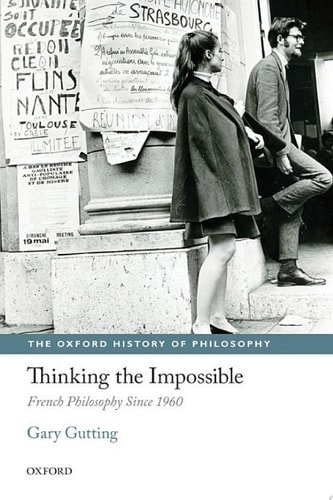
Thinking the Impossible: French Philosophy Since 1960
0
0
As an Amazon Associate and affiliate partner, Menrva Books earns from qualifying purchases. Learn more
Author Description
The late 20th century saw a remarkable flourishing of philosophy in France. The work of French philosophers is wide ranging, historically informed, often reaching out beyond the boundaries of philosophy; they are public intellectuals, taken seriously as contributors to debates outside the academy. Gary Gutting tells the story of the development of a distinctively French philosophy in the last four decades of the 20th century. His aim is to arrive at an account of what it was to 'do philosophy' in France, what this sort of philosophizing was able to achieve, and how it differs from the analytic philosophy dominant in Anglophone countries. His initial focus is on the three most important philosophers who came to prominence in the 1960s: Michel Foucault, Gilles Deleuze, and Jacques Derrida. He sets out the educational and cultural context of their work, as a basis for a detailed treatment of how they formulated and began to carry out their philosophical projects in the 1960s and 1970s. He gives a fresh assessment of their responses to the key influences of Hegel and Heidegger, and the fraught relationship of the new generation to their father-figure Sartre. He concludes that Foucault, Derrida, and Deleuze can all be seen as developing their fundamental philosophical stances out of distinctive readings of Nietzsche. The second part of the book considers topics and philosophers that became prominent in the 1980s and 1990s, such as the revival of ethics in Levinas, Derrida, and Foucault, the return to phenomenology and its use to revive religious experience as a philosophical topic, and Alain Badiou's new ontology of the event. Finally Gutting brings to the fore the meta-philosophical theme of the book, that French philosophy since the 1960s has been primarily concerned with thinking the impossible.
Menrva's Summary
THE THESIS
This book investigates the development and distinct character of French philosophy from the 1960s through the end of the 20th century. Gary Gutting, a scholar of contemporary French thought, utilizes historical context and textual analysis to argue that this philosophical tradition is defined by a unique meta-philosophical commitment to 'thinking the impossible.' He contrasts this approach with the analytic philosophy prevalent in Anglophone academia, mapping the evolution of key figures and their responses to historical influences like Hegel, Heidegger, and Nietzsche.
THE SCOPE MAP
What You Will Find
- Analysis of major figures including Michel Foucault, Gilles Deleuze, Jacques Derrida, Emmanuel Levinas, and Alain Badiou.
- Examination of the transition from 1960s structuralism and post-structuralism to the 1980s and 1990s focus on ethics and phenomenology.
- Discussion of the influence of Nietzsche, Hegel, and Heidegger on the formation of modern French philosophical projects.
- Exploration of the role of the French philosopher as a public intellectual.
Scope Limits
- The text does not provide a comprehensive survey of every minor French philosopher of the period.
- It does not attempt to bridge the divide between Continental and analytic traditions beyond identifying their fundamental differences.
THE AUTHORITY PERSPECTIVE
Experts and scholars frequently cite this work as a clear and accessible entry point into the complex landscape of late 20th-century French thought. Readers often note the balance between rigorous philosophical analysis and the historical contextualization required to understand the motivations of these thinkers.
Page Count:
225
Publication Date:
2013-01-01
Publisher:
OUP Oxford
ISBN-10:
0191057452
ISBN-13:
9780191057458
Philosophy
History & Surveys
Philosophy history
Continental Philosophy
French Philosophy
Philosophers france
Philosophy French
Intellectual History
Community Tags
Other Editions(3)

Similar Books


Reader Comments
Share Your Thoughts
No comments yet. Be the first to share your thoughts!