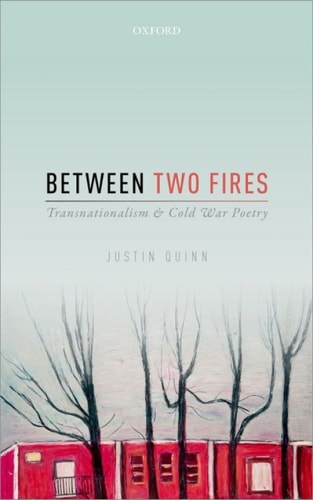
Between Two Fires: Transnationalism and Cold War Poetry
0
0
As an Amazon Associate and affiliate partner, Menrva Books earns from qualifying purchases. Learn more
Author Description
Between Two Fires is about the transnational movement of poetry during the Cold War. Beginning in the 1950s, it examines transnational engagements across the Iron Curtain, reassessing US poetry through a consideration of overlooked radical poets of the mid-century, and then asking what such transactions tell us about the way that anglophone culture absorbed new models during this period. The Cold War synchronized culture across the globe, leading to similar themes, forms, and critical maneuvers. Poetry, a discourse routinely figured as distant from political concerns, was profoundly affected by the ideological pressures of the period. But beyond such mirroring, there were many movements across the Iron Curtain, despite the barriers of cultural and language difference, state security surveillance, spies, traitors and translators. Justin Quinn shows how such factors are integral to transnational cultural movements during this period, and have influenced even postwar anglophone poetry that is thematically distant from the Cold War. For the purposes of the study, Czech poetry--its writers, its translators, its critics--stands on the other side of the Iron Curtain as receptor and, which has been overlooked, part creator, of the anglophone tradition in this period. By stepping outside the frameworks by which anglophone poetry is usually considered, we see figures such as Robert Lowell, Derek Walcott, Allen Ginsberg, and Seamus Heaney, in a new way, with respect to the ideological mechanisms that were at work behind the promotion of the aesthetic as a category independent of political considerations, foremost among these postcolonial theory.
Menrva's Summary
THE THESIS
This book investigates how the transnational movement of poetry across the Iron Curtain during the Cold War fundamentally reshaped the development of mid-century anglophone poetic traditions. Justin Quinn, a scholar of literature and translation, argues that poetry was not isolated from the era's ideological pressures but was instead deeply embedded in a network of cross-border exchanges. By utilizing Czech poetry as a primary case study for these interactions, he demonstrates how state surveillance, translation, and cultural barriers influenced the aesthetic evolution of major poets in the West.
THE SCOPE MAP
What You Will Find
- Analysis of transnational poetic exchanges between the 1950s and the end of the Cold War.
- Examination of the role of Czech poets, translators, and critics as active participants in the anglophone tradition.
- Critical reassessment of poets including Robert Lowell, Derek Walcott, Allen Ginsberg, and Seamus Heaney.
- Discussion of how ideological mechanisms promoted the concept of the aesthetic as independent from political concerns.
Scope Limits
- The study does not provide an exhaustive survey of all global Cold War poetic movements.
- It does not focus on the internal political history of the Eastern Bloc outside of its specific relevance to poetic transmission.
THE AUTHORITY PERSPECTIVE
Scholars and critics recognize this work as a significant intervention in the study of mid-century literature, particularly for its focus on the overlooked influence of Eastern European writers on Western canons. Readers frequently note the academic density of the prose, which is intended for those familiar with both Cold War history and contemporary literary theory.
Page Count:
256
Publication Date:
2015-01-01
Publisher:
OUP Oxford
ISBN-10:
0191061867
ISBN-13:
9780191061868
Poetry
Cultural History
Cold War
Transnational Studies
Literary Criticism
English
English & College Success
Community Tags
Similar Books