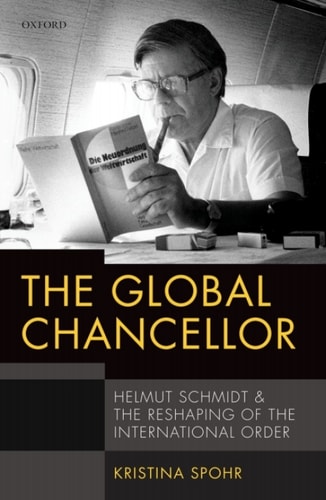
The Global Chancellor: Helmut Schmidt and the Reshaping of the International Order
0
0
As an Amazon Associate and affiliate partner, Menrva Books earns from qualifying purchases. Learn more
Author Description
Helmut Schmidt is the neglected chancellor of modern German history, overshadowed by 'the greats' - Bismarck, Adenauer, Brandt and Kohl. This volume retrieves Schmidt's true significance as a pivotal figure who helped reshape the global order during the crisis-ridden 1970s. This major reinterpretation, based on detailed research in Schmidt's private papers and numerous archives in Europe and America, reveals him as a leader equally skilled in economics and security, and adept at personal diplomacy, who dared to act as a 'double interpreter' between the superpowers during the nadir of the Cold War. Schmidt was no mere 'crisis-manager': in fact he brought to the chancellorship a depth of reflection, evident in two decades of writings and speeches that justifies considering him an intellectual statesman on a par with Henry Kissinger. His achievements were prodigious. Hailed as the 'world economist', Schmidt helped create the G7 forum for global economic governance and the European Monetary System at a time when capitalism seemed on the rocks. And as the 'strategist of balance', he designed NATO's 'dual-track' response to the crisis caused by the massive Soviet arms buildup of Euro-missiles. This decision, Kristina Spohr argues, played a crucial part in holding together the Western alliance and paved the way to defusing the Cold War in Europe. Schmidt brought his country to the top table of world politics - what he unashamedly called Weltpolitik - as an equal of the wartime victor powers. It was through his Chancellorship that West Germany came of age on the global stage.
Menrva's Summary
THE THESIS
This volume investigates the historical significance of Helmut Schmidt, arguing that he functioned as a pivotal intellectual statesman who fundamentally reshaped the international order during the 1970s. Kristina Spohr, a historian specializing in international history, utilizes extensive research from Schmidt's private papers and multi-national archives to challenge the perception of him as merely a crisis manager. She presents a framework that positions Schmidt as a 'double interpreter' between superpowers, demonstrating his dual mastery of global economic governance and security strategy.
THE SCOPE MAP
What You Will Find
- Analysis of the creation of the G7 forum and the European Monetary System.
- Examination of the 'dual-track' NATO response to Soviet Euro-missiles.
- Evaluation of West Germany's transition to a major player in global politics.
Scope Limits
- The text focuses primarily on Schmidt's international and strategic contributions rather than his domestic policy or personal life.
THE AUTHORITY PERSPECTIVE
Experts recognize this work as a significant re-evaluation of Schmidt's role in Cold War diplomacy, noting the depth of archival research employed. Readers frequently highlight the academic rigor of the prose and the author's success in elevating Schmidt's status among 20th-century political leaders.
Page Count:
240
Publication Date:
2016-01-01
Publisher:
OUP Oxford
ISBN-10:
0191064912
ISBN-13:
9780191064913
History
Biography
International relations
German history
Cold War
European History
Community Tags
Similar Books