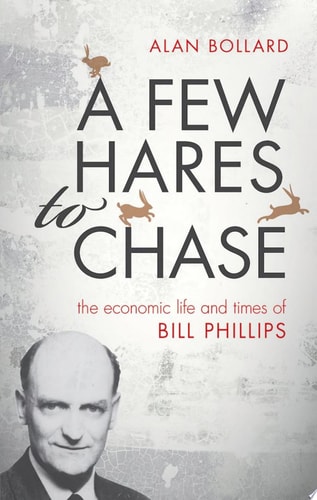
A Few Hares To Chase
0
0
As an Amazon Associate and affiliate partner, Menrva Books earns from qualifying purchases. Learn more
Author Description
The Phillips Curve Is World Famous Amongst Economists. The Man Who Invented It Was An Inventor, An Engineer, A Genius, Who Led An Exciting Life And Contributed To Economics In Many Different Ways. Born And Brought Up On A Remote Farm In Rural New Zealand, His Early Life Was A Search For Adventure. He Invented Toys And Rebuilt Machinery As A Child. He Experienced The Rigours Of The Great Depression On Construction Sites, And While Still A Young Man He Roamed The Outback Of Australia Picking Up Casual Work, Sometimes Working In Gold Mines, Sometimes Crocodile Hunting. In 1937 He Set Off To Discover Militarising Japan, A Guerrilla War In Manchuria, Stalin's Soviet Union, And The Tensions In Europe. On The Outbreak Of War, He Joined The Raf And Was Sent To Singapore Where He Rearmed Planes But Was Eventually Incarcerated In A Pow Camp By The Japanese. In Camp He Learned Languages, Invented Gadgets For The Troops And Built A Clandestine Radio. If His First 30 Years Had Been A Search For Adventure, His Later Life Was A Search For Economic Stability. Back In Britain After The War, He Scraped Through A Sociology Degree At The Lse, Before Convincing A Sceptical Faculty To Let Him Build A Hydraulic Model Of The Economy. This Beautiful Complex Machine Was A Great Success And Put Bill Phillips On The Track Of Serious Economics. In The Next Few Decades He Developed New Ideas For Stabilising Economies, Was One Of The First To Use Electronic Computers, Developed The Phillips Curve, Showed Ways To Help An Economy To Grow, And Developed New Techniques To Model Economies. Always Innovative, He Took Another Heading In His Later Years, Working Out How To Stabilise The Chinese Economy Which Was Being Wracked By The Cultural Revolution. Bill Phillips Pioneered A Dozen New Directions In Economics, Making Him One Of The Most Innovative And Influential Of Our Economic Pioneers.
Menrva's Summary
THE THESIS
This biography investigates the life and intellectual contributions of Bill Phillips, the economist responsible for the Phillips Curve, to determine how his unconventional background as an engineer and adventurer shaped his approach to economic modeling. Author Alan Bollard, an economist and former Governor of the Reserve Bank of New Zealand, utilizes archival research and historical context to trace Phillips's trajectory from a rural upbringing to his influential tenure at the London School of Economics. The book argues that Phillips's mechanical ingenuity and practical experience with global instability were the primary drivers behind his innovative, model-based approach to macroeconomic stabilization.
THE SCOPE MAP
What You Will Find
- A detailed account of Phillips's early life in rural New Zealand and his experiences during the Great Depression.
- An exploration of his wartime service, including his time as a prisoner of war in Japan.
- An analysis of his development of the MONIAC hydraulic computer and his pioneering use of electronic computing in economics.
- Insights into his later work advising on the stabilization of the Chinese economy.
Scope Limits
- The text does not provide a comprehensive technical manual for the economic theories discussed.
- It does not offer an exhaustive critique of modern macroeconomic policy beyond the context of Phillips's own contributions.
THE AUTHORITY PERSPECTIVE
Experts and readers frequently note that the book successfully bridges the gap between technical economic history and engaging biographical narrative. It is widely regarded as a foundational text for understanding the human element behind significant 20th-century economic developments.
Page Count:
224
Publication Date:
2016-01-01
Publisher:
Oxford University Press
ISBN-10:
0191064750
ISBN-13:
9780191064753
Economics
Biography
History
New Zealand
Science History
Community Tags
Other Editions(2)

Similar Books


Reader Comments
Share Your Thoughts
No comments yet. Be the first to share your thoughts!