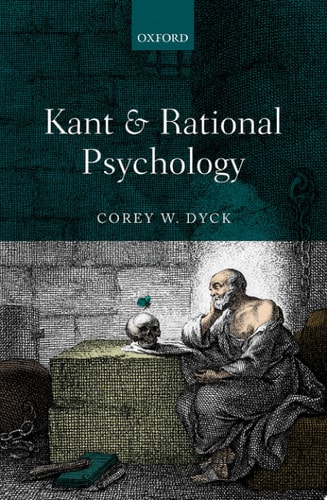
Kant and Rational Psychology
0
0
As an Amazon Associate and affiliate partner, Menrva Books earns from qualifying purchases. Learn more
Author Description
Corey W. Dyck presents a new account of Kant's criticism of the rational investigation of the soul in his monumental Critique of Pure Reason, in light of its eighteenth-century German context. When characterizing the rational psychology that is Kant's target in the Paralogisms of Pure Reason chapter of the Critique commentators typically only refer to an approach to, and an account of, the soul found principally in the thought of Descartes and Leibniz. But Dyck argues that to do so is to overlook the distinctive rational psychology developed by Christian Wolff, which emphasized the empirical foundation of any rational cognition of the soul, and which was widely influential among eighteenth-century German philosophers, including Kant. In this book, Dyck reveals how the received conception of the aim and results of Kant's Paralogisms must be revised in light of a proper understanding of the rational psychology that is the most proximate target of Kant's attack. In particular, he contends that Kant's criticism hinges upon exposing the illusory basis of the rational psychologist's claims inasmuch as he falls prey to the appearance of the soul as being given in inner experience. Moreover, Dyck demonstrates that significant light can be shed on Kant's discussion of the soul's substantiality, simplicity, personality, and existence by considering the Paralogisms in this historical context.
Menrva's Summary
THE THESIS
This book investigates the specific historical context of the rational psychology targeted by Immanuel Kant in his Paralogisms of Pure Reason. Author Corey W. Dyck, a scholar of eighteenth-century German philosophy, challenges the traditional focus on Descartes and Leibniz by centering the influence of Christian Wolff. He argues that Kant’s critique is best understood as a direct response to the Wolffian school’s specific methodology regarding the soul’s empirical foundation and its appearance in inner experience.
THE SCOPE MAP
What You Will Find
- Analysis of the Paralogisms of Pure Reason within the Critique of Pure Reason
- Examination of Christian Wolff’s rational psychology and its influence on eighteenth-century German thought
- Detailed exploration of concepts including the soul’s substantiality, simplicity, personality, and existence
Scope Limits
- The text does not provide a general introduction to Kant’s entire philosophical system
- The analysis is restricted to the specific historical dialogue between Kant and the Wolffian tradition
THE AUTHORITY PERSPECTIVE
Scholars recognize this work as a significant contribution to the historical contextualization of Kantian metaphysics. Readers frequently note the academic density of the prose, which is intended for those with a background in Enlightenment philosophy.
Page Count:
288
Publication Date:
2014-01-01
Publisher:
OUP Oxford
ISBN-10:
0191512621
ISBN-13:
9780191512629
Philosophy
Epistemology
History & Surveys
Philosophy history
Metaphysics
Community Tags
Similar Books