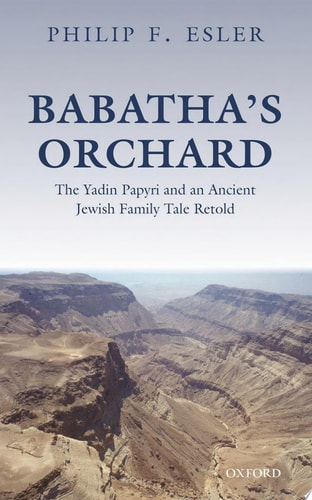
Babatha's Orchard
0
0
As an Amazon Associate and affiliate partner, Menrva Books earns from qualifying purchases. Learn more
Author Description
Babatha's Orchard Tells A Story That Has Gone Untold For Nearly Two Thousand Years. It Is A Story That Would Have Perished With The Last Person Familiar With Its Details-the Jewish Woman Babatha, Daughter Of Shim'on Ben Menahem. Babatha Was Probably Killed Or Enslaved By Roman Soldiers At The End Of Shim'on Ben Kosiba's Revolt In 135 Ce, When They Captured A Cave In A Wadi Running Into The Western Shores Of The Dead Sea In Which She And Other Jewish Fugitives Had Been Sheltering. In 1961, A Team Of Archaeologists Discovered A Cache Of Possessions That Babatha Had Carefully Hidden Before Her Life Or Freedom Was Probably Taken By The Romans. Among Them Were Thirty-five Legal Documents Dated From 94 Ce To 132 Ce, Written On Papyrus In Aramaic And Greek, Relating To Babatha And Her Family, And The Leather Pouch In Which They Had Been Kept. In This Work, Philip F. Esler Examines The First Four Documents Of The Archive In Chronological Order-papyri Yadin 1-4, The First From 94 Ce And The Second, Third And Fourth From 99 Ce, And All Drafted In Nabatean Aramaic. Although From The Land And Time Of The Bible, They Reveal A Tale Of Domestic Life. It Is The Story Of How, Around December 99 Ce, Shim'on, Babatha's Father (but Probably Before She Was Born), Unexpectedly Came To Acquire An Irrigated Date-palm Orchard In His Village Of Maoza, On The Southern Shore Of The Dead Sea, In The Kingdom Of Nabatea. Esler Undertakes A Close Reading Of P. Yadin 1-4, With Occasional Reference To Wider Contextual Issues From The Dead Sea Region And Other Parts Of The Ancient Mediterranean World.
Menrva's Summary
THE THESIS
This work investigates the legal and domestic history of a Jewish family in the ancient Nabatean kingdom through the analysis of four specific papyrus documents. Philip F. Esler, a scholar of the ancient Mediterranean, utilizes the Babatha Archive—a cache of legal documents discovered in a Dead Sea cave—to reconstruct the acquisition of a date-palm orchard in 99 CE. By applying a close reading methodology to Papyri Yadin 1-4, the author reconstructs the socio-economic realities of life in the region during the period preceding the Bar Kokhba revolt. The text bridges the gap between archaeological discovery and the lived experience of individuals in the ancient world.
THE SCOPE MAP
What You Will Find
- Detailed analysis of Papyri Yadin 1-4, written in Nabatean Aramaic.
- Historical context regarding land acquisition and domestic life in the Dead Sea region.
- Comparative analysis of legal practices in the ancient Mediterranean.
Scope Limits
- The study is strictly limited to the first four documents of the Babatha Archive.
- The book does not provide a comprehensive biography of Babatha herself, focusing instead on the specific legal transactions of her father.
THE AUTHORITY PERSPECTIVE
Scholars and historians view this work as a meticulous exercise in micro-history that provides significant insight into the legal culture of the ancient Near East. Readers frequently note the academic density of the prose, which is tailored for those with an interest in papyrology and ancient legal frameworks.
Page Count:
288
Publication Date:
2017-01-01
Publisher:
Oxford University Press
ISBN-10:
0191079898
ISBN-13:
9780191079894
History
Middle Eastern
Ancient History
Legal History
Archaeology
Community Tags
Similar Books