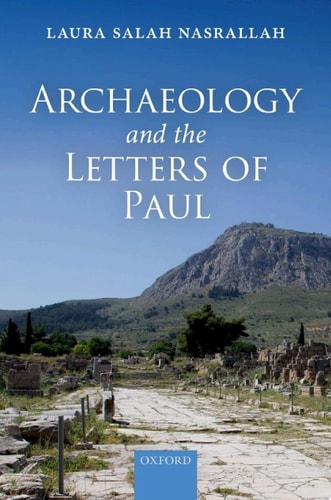
Archaeology and the Letters of Paul
0
0
As an Amazon Associate and affiliate partner, Menrva Books earns from qualifying purchases. Learn more
Author Description
Archaeology and the Letters of Paul illuminates the social, political, economic, and religious lives of those to whom the apostle Paul wrote. Roman Ephesos provides evidence of slave traders and the regulation of slaves; it is a likely setting for household of Philemon, to whom a letter about the slave Onesimus is addressed. In Galatia, an inscription seeks to restrain the demands of travelling Roman officials, illuminating how the apostolic travels of Paul, Cephas, and others disrupted communities. At Philippi, a list of donations from the cult of Silvanus demonstrates the benefactions of a community that, like those in Christ, sought to share abundance in the midst of economic limitations. In Corinth, a landscape of grief extends from monuments to the bones of the dead, and provides a context in which to understand Corinthian practices of baptism on behalf of the dead and the provocative idea that one could live "as if not" mourning or rejoicing. Rome and the Letter to the Romans are the grounds for an investigation of ideas of time and race not only in the first century, when we find an Egyptian obelisk inserted as a timepiece into the mausoleum complex of Augustus, but also of a new Rome under Mussolini that claimed the continuity of Roman racial identity from antiquity to his time and sought to excise Jews. Thessalonike and the early Christian literature associated with the city demonstrates what is done out of love for Paul-invention of letters, legends, and cult in his name. The book articulates a method for bringing together biblical texts with archaeological remains. This method reconstructs the lives of the many adelphoi ——brothers and sisters—— whom Paul and his co-writers address. Its project is informed by feminist historiography and gains inspiration from thinkers such as Claudia Rankine, Judith Butler, Giorgio Agamben, Wendy Brown, and Katie Lofton.
Menrva's Summary
THE THESIS
This work investigates how archaeological evidence from the Roman Empire provides a necessary social and political context for interpreting the letters of the apostle Paul. Laura Salah Nasrallah, a scholar of New Testament and early Christian literature, utilizes a methodology that bridges biblical exegesis with material culture. By examining inscriptions, urban landscapes, and monuments, she argues that the lives of the early Christian communities addressed by Paul can be reconstructed with greater precision than text alone allows. The book integrates feminist historiography and contemporary critical theory to challenge traditional readings of these ancient documents.
THE SCOPE MAP
What You Will Find
- Analysis of archaeological sites including Ephesos, Galatia, Philippi, Corinth, Rome, and Thessalonike.
- Methodological framework for integrating material remains with epistolary texts.
- Examination of themes such as slavery, economic benefaction, grief, time, and racial identity.
- Application of critical theory from thinkers like Judith Butler and Giorgio Agamben to ancient contexts.
Scope Limits
- The text does not provide a comprehensive theological commentary on every verse of the Pauline epistles.
- It does not attempt to reconstruct a complete biography of Paul, focusing instead on the communities he addressed.
THE AUTHORITY PERSPECTIVE
Scholars and students of early Christianity recognize this text as a significant methodological contribution to the field of biblical archaeology. Readers frequently note the academic density of the prose and the sophisticated integration of contemporary critical theory with ancient material evidence.
Page Count:
328
Publication Date:
2018-01-01
Publisher:
OUP Oxford
ISBN-10:
0191081744
ISBN-13:
9780191081743
History
Religion
New Testament
Bible
Bibles
Archaeology
Paul the Apostle Saint
Community Tags
Similar Books