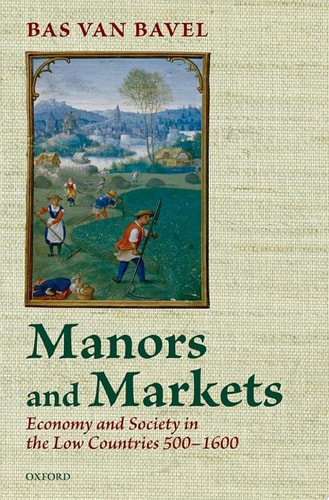
Manors and Markets: Economy and Society in the Low Countries 500-1600
0
0
As an Amazon Associate and affiliate partner, Menrva Books earns from qualifying purchases. Learn more
Author Description
The Low Countries -- an area roughly embracing the present-day Netherlands and Belgium -- formed a patchwork of varied economic and social development in the Middle Ages, with some regions displaying a remarkable dynamism. Manors and Markets charts the history of these vibrant economies and societies, and contrasts them with alternative paths of development, from the early medieval period to the beginning of the seventeenth century. Providing a concise overview of social and economic changes over more than a thousand years, Bas van Bavel assesses the impact of the social and institutional organization that saw the Low Countries become the most urbanized and densely populated part of Europe by the end of the Middle Ages. By delving into the early and high medieval history of society, van Bavel uncovers the foundations of the flourishing of the medieval Flemish towns and the forces that propelled Holland towards its Golden Age. Exploring the Low Countries at a regional level, van Bavel highlights the importance of localized structures for determining the nature of social transitions and economic growth. He assesses the role of manorial organization, the emergence of markets, the rise of towns, the quest for self-determination by ordinary people, and the sharp regional differences in development that can be observed in the very long run. In doing so, the book offers a significant contribution to the debate about the causes of economic and social change, both past and present.
Menrva's Summary
THE THESIS
This work investigates the factors behind the exceptional economic and social development of the Low Countries between 500 and 1600. Bas van Bavel, a professor of transitions in economy and society, utilizes a comparative regional framework to analyze how institutional structures and social organization facilitated the region's transition into the most urbanized area of Europe. The text argues that localized social structures and the interplay between manorial systems and market emergence were the primary drivers of long-term economic growth and divergence.
THE SCOPE MAP
What You Will Find
- Analysis of economic and social development in the Netherlands and Belgium from 500 to 1600.
- Examination of the transition from manorial organization to market-oriented economies.
- Comparative regional studies of Flemish towns and the rise of Holland.
- Assessment of the role of self-determination and institutional frameworks in social change.
Scope Limits
- The analysis focuses primarily on the Low Countries and does not provide a comprehensive history of broader European economic systems.
- The text prioritizes structural and institutional factors over detailed political or military history.
THE AUTHORITY PERSPECTIVE
Scholars and historians recognize this text as a rigorous synthesis of medieval and early modern economic development in the Low Countries. Readers frequently note the academic density of the prose, which provides a detailed, evidence-based account suitable for students and researchers of economic history.
Page Count:
512
Publication Date:
2016-01-01
Publisher:
OUP Oxford
ISBN-10:
0191086657
ISBN-13:
9780191086656
History
Economic History
European History
Low Countries
Social History
Community Tags
Similar Books