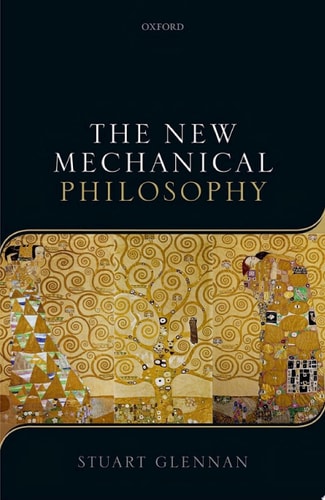
The New Mechanical Philosophy
0
0
As an Amazon Associate and affiliate partner, Menrva Books earns from qualifying purchases. Learn more
Author Description
The New Mechanical Philosophy argues for a new image of nature and of science--one that understands both natural and social phenomena to be the product of mechanisms, and that casts the work of science as an effort to discover and understand those mechanisms. Drawing on an expanding literature on mechanisms in physical, life, and social sciences, Stuart Glennan offers an account of the nature of mechanisms and of the models used to represent them. A key quality of mechanisms is that they are particulars - located at different places and times, with no one just like another. The crux of the scientist's challenge is to balance the complexity and particularity of mechanisms with our need for representations of them that are abstract and general. This volume weaves together metaphysical and methodological questions about mechanisms. Metaphysically, it explores the implications of the mechanistic framework for our understanding of classical philosophical questions about the nature of objects, properties, processes, events, causal relations, natural kinds and laws of nature. Methodologically, the book explores how scientists build models to represent and understand phenomena and the mechanisms responsible for them. Using this account of representation, Glennan offers a scheme for characterizing the enormous diversity of things that scientists call mechanisms, and explores the scope and limits of mechanistic explanation.
Menrva's Summary
THE THESIS
This book investigates whether the concept of mechanisms provides a sufficient framework for understanding both natural and social phenomena in scientific inquiry. Stuart Glennan, a philosopher of science, synthesizes literature from the physical, life, and social sciences to propose a new image of nature. He argues that science is fundamentally an effort to discover and represent mechanisms, which are unique, time-bound particulars that require abstract modeling to be understood.
THE SCOPE MAP
What You Will Find
- A metaphysical analysis of objects, properties, processes, and causal relations.
- A methodological framework for how scientists construct models of mechanisms.
- A classification scheme for the diversity of mechanisms found across scientific disciplines.
Scope Limits
- The text does not provide a comprehensive history of mechanical philosophy from the Enlightenment to the present.
- It does not offer a practical manual for laboratory experimentation or specific scientific data collection.
THE AUTHORITY PERSPECTIVE
Experts identify this work as a significant contribution to the contemporary debate on mechanistic explanation in the philosophy of science. Readers frequently note the academic density of the prose, which requires a strong background in analytical philosophy to fully grasp the author's arguments.
Page Count:
278
Publication Date:
2017-01-01
Publisher:
OUP Oxford
ISBN-10:
0191085294
ISBN-13:
9780191085291
Philosophy
Philosophy of
Science
Epistemology
Metaphysics
Community Tags
Other Editions(4)


Similar Books















Reader Comments
Share Your Thoughts
No comments yet. Be the first to share your thoughts!