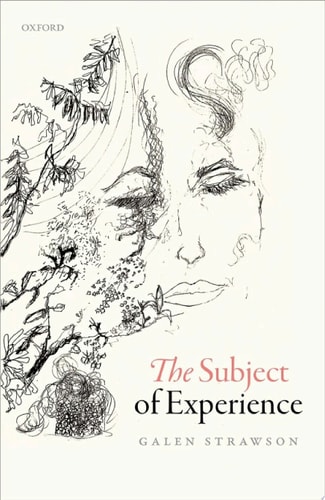
The Subject of Experience
0
0
As an Amazon Associate and affiliate partner, Menrva Books earns from qualifying purchases. Learn more
Author Description
The Subject of Experience is about the self, the person. It takes the form of a series of essays which draw on literature and psychology as well as philosophy. Galen Strawson discusses the phenomenology or experience of having or being a self (What is the character of self-experience?) and the fundamental metaphysics of the self (Does the self exist? If so, what is its nature? How long do selves last?): he develops an approach to the metaphysical questions out of the results of the phenomenological investigation. He argues that it is legitimate to say that there is such a thing as the self as distinct from the human being. At the same time he raises doubts about how long selves can be supposed to last, insofar as they are distinct from human beings. He also raises a doubt about whether a self (or indeed a human being) can really be said to lose anything in dying. He criticizes the popular notion of the narrative self, and considers the differences between 'Endurers' or 'Diachronic' people, who feel that they are the same person when they consider their past and future, and 'Transients' or 'Episodic' people, who do not feel this. He considers the first-person pronoun 'I' and a number of puzzles raised by the phenomena of self-reference and self-knowledge. He examines Locke's, Hume's and Kant's accounts of the mind and personal identity, and argues that Locke and Hume have been badly misunderstood.
Menrva's Summary
THE THESIS
This work investigates the fundamental nature of the self by examining the intersection of phenomenological experience and metaphysical reality. Galen Strawson, a prominent philosopher, utilizes a series of essays to bridge the gap between subjective experience and objective identity. By analyzing historical accounts from Locke, Hume, and Kant alongside contemporary psychological observations, he constructs an argument regarding the existence and temporal duration of the self as distinct from the human being.
THE SCOPE MAP
What You Will Find
- Analysis of the phenomenology of self-experience and self-reference.
- A distinction between 'Endurer' (diachronic) and 'Transient' (episodic) modes of self-perception.
- Critical re-evaluations of classical philosophical accounts of personal identity.
- Examination of the linguistic and metaphysical implications of the first-person pronoun 'I'.
Scope Limits
- The text does not provide a definitive biological or neuroscientific explanation of consciousness.
- It avoids offering a singular, unified theory of the self, focusing instead on raising critical doubts and distinctions.
THE AUTHORITY PERSPECTIVE
Scholars and students of philosophy frequently cite this text for its rigorous re-examination of canonical figures like Locke and Hume. Readers often note the high level of conceptual density, marking it as a significant contribution to contemporary debates on personal identity and narrative selfhood.
Page Count:
331
Publication Date:
2017-01-01
Publisher:
OUP Oxford
ISBN-10:
019108364X
ISBN-13:
9780191083648
Philosophy
Psychology
Self
Phenomenology
Personal Identity
Metaphysics
Community Tags
Similar Books