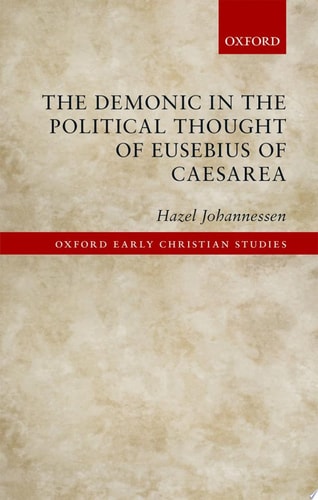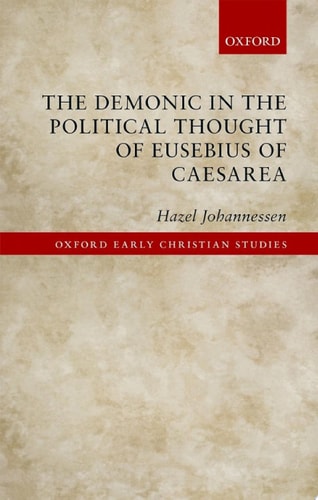
The Demonic in the Political Thought of Eusebius of Caesarea
0
0
As an Amazon Associate and affiliate partner, Menrva Books earns from qualifying purchases. Learn more
Author Description
The Demonic in the Political Thought of Eusebius of Caesarea explores how Eusebius of Caesarea's ideas about demons interacted with and helped to shape his thought on other topics, particularly political topics Hazel Johannessen builds on and complements recent work on early Christian and early modern demonology. Eusebius' political thought has long drawn the attention of scholars who have identified in some of his works the foundations of later Byzantine theories of kingship. However, Eusebius' political thought has not previously been examined in the light of his views on demons. Moreover, despite frequent references to demons throughout many of Eusebius' works, there has been no comprehensive study of Eusebius' views on demons, until now, as expressed throughout a range of his works. The originality of this study lies both in an initial examination of Eusebius' views on demons and their place in his cosmology, and in the application of the insights derived from this to consideration of his political thought. As a result of this new perspective, Johannessen challenges scholars' traditional characterization of Eusebius as a triumphal optimist. Instead, she draws attention to his concerns about a continuing demonic threat, capable of disrupting humankind's salvation, and presents Eusebius as a more cautious figure than the one familiar to late antique scholarship.
Menrva's Summary
THE THESIS
This study investigates how Eusebius of Caesarea’s conceptualization of the demonic functions as a critical, previously overlooked framework for understanding his political theory. Hazel Johannessen, a scholar of early Christian thought, synthesizes a wide range of Eusebian texts to argue that his political writings are deeply informed by a persistent anxiety regarding demonic influence. By moving beyond the traditional view of Eusebius as a triumphalist, Johannessen presents a more nuanced portrait of a thinker preoccupied with the fragility of human salvation against spiritual threats.
THE SCOPE MAP
What You Will Find
- An analysis of Eusebius' cosmology and the specific role of demons within it.
- A re-evaluation of Byzantine theories of kingship through the lens of spiritual warfare.
- A comprehensive survey of demonic references across the breadth of Eusebius' literary output.
Scope Limits
- The study does not provide a general biography of Eusebius or a broad history of early Christian demonology outside the context of his specific political thought.
THE AUTHORITY PERSPECTIVE
Scholars recognize this work as a significant intervention in patristic studies that successfully challenges the long-standing characterization of Eusebius as a simple optimist. The text is noted for its academic rigor and its ability to synthesize complex theological concepts with political history for an audience of specialists.
Page Count:
272
Publication Date:
2016-01-01
Publisher:
OUP Oxford
ISBN-10:
0191091049
ISBN-13:
9780191091049
History
Religion
Philosophy
Patristics
Theology