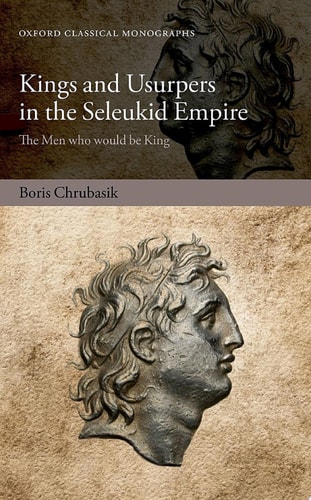
Kings and Usurpers in the Seleukid Empire: The Men Who Would Be King
0
0
As an Amazon Associate and affiliate partner, Menrva Books earns from qualifying purchases. Learn more
Author Description
Kings and Usurpers in the Seleukid Empire: The Men who would be King focuses on ideas of kingship and power in the Seleukid empire, the largest of the successor states of Alexander the Great. Exploring the question of how a man becomes a king, it specifically examines the role of usurpers in this particular kingdom - those who attempted to become king, and who were labelled as rebels by ancient authors after their demise - by placing these individuals in their appropriate historical contexts through careful analysis of the literary, numismatic, and epigraphic material. By writing about kings and rebels, literary accounts make a clear statement about who had the right to rule and who did not, and the Seleukid kings actively fostered their own images of this right throughout the third and second centuries BCE. However, what emerges from the documentary evidence is a revelatory picture of a political landscape in which kings and those who would be kings were in constant competition to persuade whole cities and armies that they were the only plausible monarch, and of a right to rule that, advanced and refuted on so many sides, simply did not exist. Through careful analysis, this volume advances a new political history of the Seleukid empire that is predicated on social power, redefining the role of the king as only one of several players within the social world and offering new approaches to the interpretation of the relationship between these individuals themselves and with the empire they sought to rule. In doing so, it both questions the current consensus on the Seleukid state, arguing instead that despite its many strong rulers the empire was structurally weak, and offers a new approach to writing political history of the ancient world.
Menrva's Summary
THE THESIS
This volume investigates the nature of political legitimacy and the mechanics of power within the Seleukid Empire by analyzing the role of usurpers. Boris Chrubasik, a scholar of the Hellenistic period, utilizes a multidisciplinary approach to challenge traditional narratives of monarchical authority. By examining the discrepancy between literary portrayals of 'rebels' and the actual political landscape, the author argues that the Seleukid state was structurally weak and that the right to rule was a fluid, contested concept rather than an established legal reality.
THE SCOPE MAP
What You Will Find
- Analysis of political power dynamics during the third and second centuries BCE.
- Examination of the relationship between monarchs, cities, and armies.
- Integration of literary, numismatic, and epigraphic evidence.
Scope Limits
- The study focuses primarily on the mechanisms of usurpation and legitimacy rather than a comprehensive chronological narrative of every Seleukid ruler.
- It does not provide an exhaustive military history of the empire's external conflicts.
THE AUTHORITY PERSPECTIVE
Scholars recognize this work as a significant contribution to Hellenistic political history, particularly for its critical re-evaluation of the Seleukid power structure. Readers frequently note the academic density of the prose and the rigorous methodology applied to the interpretation of ancient source material.
Page Count:
332
Publication Date:
2016-01-01
Publisher:
OUP Oxford
ISBN-10:
0191090611
ISBN-13:
9780191090615
History
Political History
Greece
Ancient History
kingship
Community Tags
Similar Books