Graffiti and the Literary Landscape in Roman Pompeii
0
0
As an Amazon Associate and affiliate partner, Menrva Books earns from qualifying purchases. Learn more
Author Description
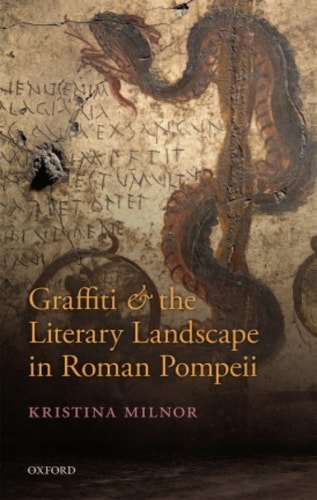
In this volume, Milnor considers how the fragments of textual graffiti which survive on the walls of the Roman city of Pompeii reflect and refract the literary world from which they emerged. Focusing in particular on the writings which either refer to or quote canonical authors directly, Milnor uncovers the influence-- in diction, style, or structure--of elite Latin literature as the Pompeian graffiti show significant connections with familiar authors such as Ovid, Propertius, and Virgil. While previous scholarship has described these fragments as popular distortions of well-known texts, Milnor argues that they are important cultural products in their own right, since they are able to give us insight into how ordinary Romans responded to and sometimes rewrote works of canonical literature. Additionally, since graffiti are at once textual and material artefacts, they give us the opportunity to see how such writings gave meaning to, and were given meaning by, the ancient urban environment. Ultimately, the volume looks in detail at the role and nature of 'popular' literature in the early Roman Empire and the place of poetry in the Pompeian cityscape.
Menrva's Summary
THE THESIS
This volume investigates how the textual graffiti found in Pompeii reflect and interact with the canonical literary traditions of the early Roman Empire. Kristina Milnor, a scholar of classical literature, examines these wall inscriptions not as mere distortions of elite texts, but as significant cultural artifacts. By analyzing specific graffiti that quote or reference authors such as Ovid, Propertius, and Virgil, she argues that ordinary Romans actively engaged with and reshaped high-culture literature within their daily urban environment.
THE SCOPE MAP
What You Will Find
- Analysis of graffiti containing direct quotes or stylistic echoes of canonical Latin poets
- Examination of the intersection between material culture and textual production in Pompeii
- Theoretical framework regarding the role of popular literature in the Roman cityscape
Scope Limits
- The study is geographically restricted to the archaeological site of Pompeii
- It does not provide a comprehensive catalog of all Pompeian graffiti, focusing instead on literary connections
THE AUTHORITY PERSPECTIVE
Scholars recognize this work as a significant contribution to the study of Roman epigraphy and the reception of classical literature among non-elite populations. The text is noted for its academic rigor and its ability to bridge the gap between material archaeology and literary analysis.
Page Count:
336
Publication Date:
2014-01-01
Publisher:
OUP Oxford
ISBN-10:
0191509337
ISBN-13:
9780191509339
History
Epigraphy
English & College Success
Roman Empire
Literary Criticism
English
Archaeology
Criticism history
Community Tags
Other Editions(2)

Similar Books