Faust: Part One
0
0
As an Amazon Associate and affiliate partner, Menrva Books earns from qualifying purchases. Learn more
Author Description
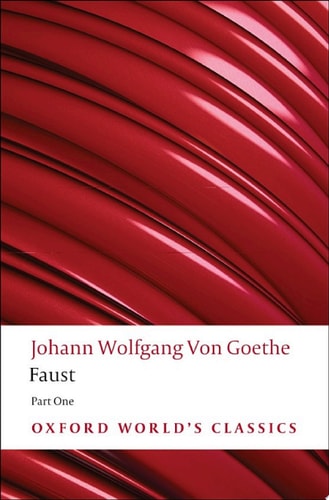
The legend of Faust grew up in the sixteenth century, a time of transition between medieval and modern culture in Germany. Johann Wolfgang von Goethe (1749-1832) adopted the story of the wandering conjuror who accepts Mephistopheles's offer of a pact, selling his soul for the devil's greater knowledge; over a period of 60 years he produced one of the greatest dramatic and poetic masterpieces of European literature. David Luke's recent translation, specially commissioned for The World's Classics series, has all the virtues of previous classic translations of Faust, and none of their shortcomings. Cast in rhymed verse, following the original, it preserves the essence of Goethe's meaning without sacrifice to archaism or over-modern idiom. It is as near an `equivalent' rendering of the German as has been achieved. ABOUT THE SERIES: For over 100 years Oxford World's Classics has made available the widest range of literature from around the globe. Each affordable volume reflects Oxford's commitment to scholarship, providing the most accurate text plus a wealth of other valuable features, including expert introductions by leading authorities, helpful notes to clarify the text, up-to-date bibliographies for further study, and much more.
Menrva's Summary
THE PULSE
The scholar Faust, disillusioned with the limits of human knowledge, enters into a perilous pact with the devil Mephistopheles to experience the fullness of life. Driven by an insatiable desire for transcendence, Faust abandons his academic isolation to pursue worldly pleasures and forbidden insights. He is opposed by the cynical, manipulative Mephistopheles, who seeks to win Faust's soul through a series of increasingly complex trials. The narrative unfolds through a dramatic framework, utilizing shifting verse forms to capture the psychological turbulence of the protagonist. The world is defined by a collision between the mundane reality of 16th-century Germany and the supernatural machinations of the demonic realm.
INSIDE THE PAGES
- Dramatic verse structure utilizing varied rhyme schemes
- Exploration of the conflict between intellectual ambition and moral integrity
- Supernatural intervention as a catalyst for character development
- Integration of folklore and historical legend
- Philosophical inquiry into the nature of human desire
- Use of allegorical characters to represent human archetypes
- Non-linear progression of scenes reflecting Faust's internal state
- Linguistic precision aimed at maintaining the rhythm of the original German
THE COLLECTIVE ECHO
Discussion often centers on the intricate balance between the play's theological weight and its satirical elements. Readers frequently highlight the effectiveness of the verse translation in maintaining the urgency of Goethe's original German text. Critics often examine the characterization of Mephistopheles as a complex agent of chaos rather than a traditional villain. The work is widely recognized for its influence on the development of modern European literature and its enduring exploration of the human condition. Scholars and casual readers alike note the density of the philosophical themes presented within the dramatic structure.
Page Count:
241
Publication Date:
1987-01-01
Publisher:
OUP Oxford
ISBN-10:
0191501255
ISBN-13:
9780191501258
Drama
Poetry
Fantasy
Philosophical
English
Humanities
Theatre
German
Classic Literature
Special Topics
English & College Success
Community Tags
Similar Books