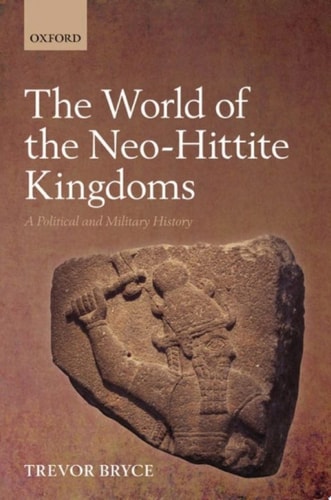
The World of the Neo-Hittite Kingdoms: A Political and Military History
0
0
As an Amazon Associate and affiliate partner, Menrva Books earns from qualifying purchases. Learn more
Author Description
In the early 12th century, the Late Bronze Age Hittite empire collapsed during a series of upheavals which swept the Greek and Near Eastern worlds. In the subsequent Iron Age, numerous cities and states emerged in south-eastern Anatolia and northern Syria, which are generally known today as the 'Neo-Hittite kingdoms'. Bryce's volume gives an account of the military and political history of these kingdoms, moving beyond the Neo-Hittites themselves to the broader Near Eastern world and the states which dominated it during the Iron Age. Divided into three sections, The World of Neo-Hittite Kingdoms looks at the last decades of the empire and the features of these kingdoms and their subsequent treatment under their Anatolian successors. Through a closer look at the individual Neo-Hittite kingdoms and their rulers and a comparison with the contemporary Aramaean states and the other kingdoms of the age - notably the Neo-Assyrian empire - it concludes with a historical synthesis of the Neo-Hittites when the last kingdom was absorbed into the Assyrian provincial administration.
Menrva's Summary
THE THESIS
This volume investigates the political and military evolution of the Neo-Hittite kingdoms following the collapse of the Late Bronze Age Hittite empire. Trevor Bryce, a recognized authority on Hittite history, utilizes archaeological evidence and historical records to reconstruct the trajectory of these successor states. The work provides a comprehensive framework for understanding how these entities navigated the geopolitical landscape of the Iron Age before their eventual integration into the Neo-Assyrian empire.
THE SCOPE MAP
What You Will Find
- Analysis of the transition from the Late Bronze Age to the Iron Age in Anatolia and Syria.
- Detailed political and military histories of individual Neo-Hittite kingdoms.
- Comparative studies between Neo-Hittite states, Aramaean kingdoms, and the Neo-Assyrian empire.
Scope Limits
- The text does not provide an exhaustive archaeological catalog of every site associated with the period.
- It focuses primarily on political and military history rather than social or daily life history.
THE AUTHORITY PERSPECTIVE
Scholars and students of the ancient Near East frequently cite this work as a definitive political survey of the post-Hittite era. Readers often note the clarity of the prose, which makes complex regional power dynamics accessible to both academic and non-specialist audiences.
Page Count:
371
Publication Date:
2012-01-01
Publisher:
OUP Oxford
ISBN-10:
0191505021
ISBN-13:
9780191505027
History
Military History
Near Eastern Studies
Political History
Archaeology
Ancient History
Community Tags
Similar Books














