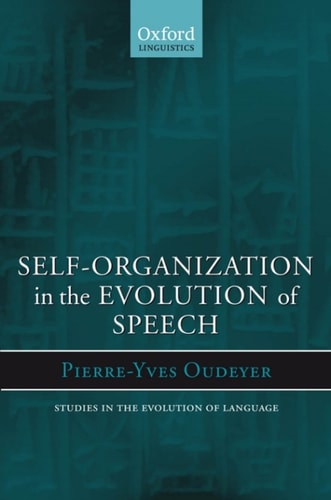
Self-Organization in the Evolution of Speech
0
0
As an Amazon Associate and affiliate partner, Menrva Books earns from qualifying purchases. Learn more
Author Description
Speech is the principal supporting medium of language. In this book Pierre-Yves Oudeyer considers how spoken language first emerged. He presents an original and integrated view of the interactions between self-organization and natural selection, reformulates questions about the origins of speech, and puts forward what at first sight appears to be a startling proposal - that speech can be spontaneously generated by the coupling of evolutionarily simple neural structures connecting perception and production. He explores this hypothesis by constructing a computational system to model the effects of linking auditory and vocal motor neural nets. He shows that a population of agents which used holistic and unarticulated vocalizations at the outset are inexorably led to a state in which their vocalizations have become discrete, combinatorial, and categorized in the same way by all group members. Furthermore, the simple syntactic rules that have emerged to regulate the combinations of sounds exhibit the fundamental properties of modern human speech systems. This original and fascinating account will interest all those interested in the evolution of speech.
Menrva's Summary
THE THESIS
This book investigates the origins of spoken language by examining how self-organization and natural selection interact to produce complex vocal systems. Pierre-Yves Oudeyer, a researcher in developmental robotics and artificial intelligence, utilizes computational modeling to challenge traditional views on language evolution. He argues that the fundamental properties of human speech may emerge spontaneously from the coupling of simple neural structures responsible for perception and production, rather than requiring complex innate biological adaptations.
THE SCOPE MAP
What You Will Find
- Computational models simulating the interaction between auditory and vocal motor neural networks
- Analysis of the transition from holistic vocalizations to discrete, combinatorial speech systems
- Theoretical framework integrating self-organization with evolutionary theory
- Examination of the emergence of syntactic rules in simulated agent populations
Scope Limits
- Does not provide a comprehensive history of all linguistic evolution
- Focuses primarily on the mechanical and structural origins of speech rather than semantic or social development
THE AUTHORITY PERSPECTIVE
Experts recognize this work as a significant contribution to the field of evolutionary linguistics, particularly for its innovative use of computational modeling to test theoretical hypotheses. Readers frequently note the technical density of the prose, which assumes a foundational understanding of both neural networks and evolutionary biology.
Page Count:
192
Publication Date:
2006-01-01
Publisher:
Oxford University Press, U.S.A.
ISBN-10:
0191516104
ISBN-13:
9780191516108
Linguistics
Evolutionary Biology
Speech Science
English
English & College Success
Community Tags
Other Editions(3)

Similar Books