Theory and Truth: Philosophical Critique within Foundational Science
0
0
As an Amazon Associate and affiliate partner, Menrva Books earns from qualifying purchases. Learn more
Author Description
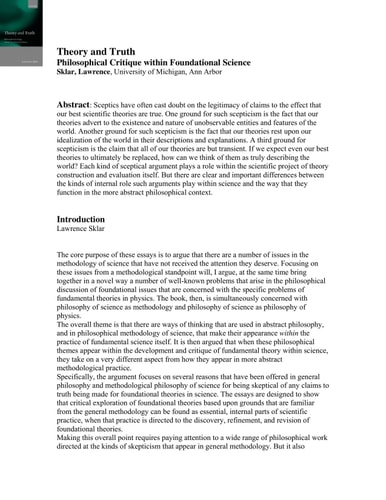
Skeptics Have Cast Doubt On The Idea That Scientific Theories Give Us A True Picture Of An Objective World. Lawrence Sklar Examines Three Kinds Of Skeptical Arguments About Scientific Truth, And Explores The Important Role That These Play Within Foundational Science Itself, Especially Physics. First, Doubts Have Been Expressed About The Legitimacy Of Claiming Truth For Assertions About The Realm Of The Unobservable. Second, Scientific Theories Have Been Characterized As Relying Heavily On Idealization Of The Physical Systems They Seek To Describe. Third, It Is Noted That Scientific Theories Tend To Be Transient, And Even The Best Currently Available Are Expected To Be Replaced In The Future. Sklar Demonstrates That These Kinds Of Philosophical Critique Are Employed Within Science Itself, And Reveals The Clear Difference Between How They Operate In A Scientific And In A More Abstract Philosophical Context. The Underlying Theme Of Theory And Truth Is That Science And Philosophy Are Essential To, And Inextricable From, Each Other. One Cannot Understand The Methods Of Science Except By Understanding Philosophy, And One Cannot Fruitfully Pursue Philosophy Of Science Without Understanding Foundational Science As Well.
Menrva's Summary
THE THESIS
This work investigates the tension between scientific realism and skepticism, questioning whether scientific theories can provide an accurate representation of an objective reality. Lawrence Sklar, a prominent philosopher of science, analyzes three primary skeptical challenges: the status of unobservable entities, the reliance on idealization in physical modeling, and the historical transience of scientific theories. He argues that these critiques are not merely external philosophical exercises but are integral components of scientific practice itself, demonstrating that science and philosophy are mutually dependent disciplines.
THE SCOPE MAP
What You Will Find
- Analysis of the epistemic status of unobservable entities in physics
- Examination of the role of idealization in physical system modeling
- Discussion on the implications of theory change and scientific progress
- Comparative study of philosophical versus scientific applications of critical skepticism
Scope Limits
- The text focuses primarily on foundational physics rather than the biological or social sciences
- It does not provide a comprehensive history of scientific realism but focuses on specific skeptical arguments
THE AUTHORITY PERSPECTIVE
Experts recognize this text as a sophisticated contribution to the philosophy of physics that bridges the gap between abstract epistemology and actual scientific practice. Readers frequently note the academic density of the prose, which requires a solid background in both philosophy and foundational physics to fully appreciate the arguments presented.
Page Count:
153
Publication Date:
2005-01-01
Publisher:
Oxford University Press
ISBN-10:
0191519448
ISBN-13:
9780191519444
Philosophy
Science
Knowledge Theory
Physics
Epistemology
Philosophy of
Community Tags
Similar Books