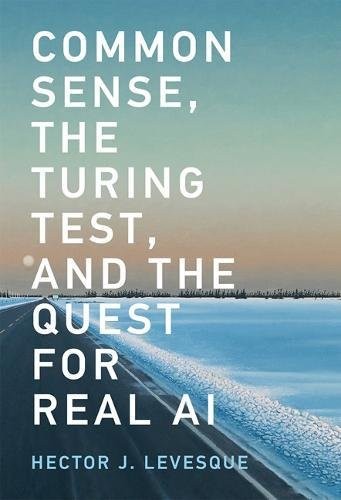
Common Sense, the Turing Test, and the Quest for Real AI
0
0
As an Amazon Associate and affiliate partner, Menrva Books earns from qualifying purchases. Learn more
Author Description
What can artificial intelligence teach us about the mind? If AI's underlying concept is that thinking is a computational process, then how can computation illuminate thinking? It's a timely question. AI is all the rage, and the buzziest AI buzz surrounds adaptive machine learning: computer systems that learn intelligent behavior from massive amounts of data. This is what powers a driverless car, for example. In this book, Hector Levesque shifts the conversation to good old fashioned artificial intelligence, which is based not on heaps of data but on understanding commonsense intelligence. This kind of artificial intelligence is equipped to handle situations that depart from previous patterns, as we do in real life, when, for example, we encounter a washed-out bridge or when the barista informs us there's no more soy milk. Levesque considers the role of language in learning. He argues that a computer program that passes the famous Turing Test could be a mindless zombie, and he proposes another way to test for intelligence -- the Winograd Schema Test, developed by Levesque and his colleagues. If our goal is to understand intelligent behavior, we had better understand the difference between making it and faking it, he observes. He identifies a possible mechanism behind common sense and the capacity to call on background knowledge: the ability to represent objects of thought symbolically. As AI migrates more and more into everyday life, we should worry if systems without common sense are making decisions where common sense is needed.
Menrva's Summary
THE THESIS
The central question of this book is whether current approaches to artificial intelligence, particularly machine learning, can truly replicate human intelligence, or if a different path focused on commonsense reasoning is necessary. The author, Hector Levesque, a computer scientist, argues that while machine learning excels at pattern recognition from vast datasets, it falls short in handling novel situations that require commonsense understanding, unlike humans who can adapt to unexpected events. He critiques the Turing Test as insufficient for identifying genuine intelligence, proposing the Winograd Schema Test as a more robust alternative. Levesque explores the role of symbolic representation in enabling commonsense reasoning and highlights the potential dangers of deploying AI systems lacking this crucial capability in everyday life.
THE SCOPE MAP
- What artificial intelligence can teach us about the human mind.
- The limitations of machine learning and big data approaches to AI.
- The concept of commonsense intelligence and its importance for AI.
- The role of language and symbolic representation in learning and intelligence.
- Critique of the Turing Test and proposal of the Winograd Schema Test.
- Distinguishing between making intelligence and faking intelligence.
- The mechanism behind commonsense reasoning and background knowledge.
- Implications of AI migration into everyday life and the need for commonsense systems.
THE AUTHORITY PERSPECTIVE
The book is likely to be appreciated by readers interested in the foundational concepts of artificial intelligence and the philosophy of mind, offering a counterpoint to the current hype around machine learning. Levesque's focus on commonsense reasoning and his proposed Winograd Schema Test provide a distinct perspective on evaluating AI capabilities. The work aims to clarify the difference between systems that can perform tasks and those that genuinely understand, a distinction crucial as AI becomes more integrated into society. It serves as a thoughtful examination of what true intelligence entails.
Page Count:
172
Publication Date:
2017-01-01
ISBN-10:
0262036045
ISBN-13:
9780262036047
Science
Non-Fiction
Philosophy
Art
Computer Science