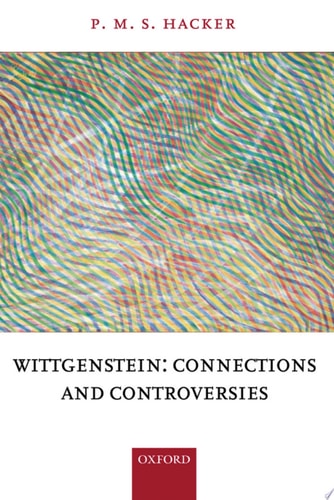
Wittgenstein: Connections and Controversies
0
0
As an Amazon Associate and affiliate partner, Menrva Books earns from qualifying purchases. Learn more
Author Description
Wittgenstein: Connections and Controversies consists of thirteen thematically linked essays on different aspects of the philosophy of Wittgenstein, by one of the leading commentators on his work. After an opening overview of Wittgenstein's philosophy the following essays fall into two classes: those that investigate connections between the philosophy of Wittgenstein and other philosophers and philosophical trends, and those which enter into some of the controversies that, over the last two decades, have raged over the interpretation of one aspect or another of Wittgenstein's writings. The connections that are explored include the relationship between Wittgenstein's philosophy and the humanistic and hermeneutic traditions in European philosophy, Wittgenstein's response to Frazer's Golden Bough and the interpretation of ritual actions, his attitude towards and criticisms of Frege (both in the Tractatus and in the later philosophy), the relationship between his ideas and those of members of the Vienna Circle on the matter of ostensive definition, and a comparison of Carnap's conception of the elimination of metaphysics and of Strawson's rehabilitation of metaphysics with Wittgenstein's later criticisms of metaphysics. The controversies into which Hacker enters include the Diamond-Conant interpretation of the Tractatus (which is shown to be inconsistent with the text of the Tractatus and with Wittgenstein's explanations of and comments on his book), Winch's interpretation of the Tractatus conception of names, Kripke's interpretation of Wittgenstein's discussion of following a rule (which is demonstrated to be remote from Wittgenstein's intentions), and Malcolm's defence of the idea that Wittgenstein claimed that mastery of a language logically requires that the language be shared with other speakers. These far-ranging essays, several of them previously unpublished or difficult to find, shed much light upon different aspects of Wittgenstein's thought, and upon the contro
Menrva's Summary
THE THESIS
This collection of essays investigates the core tenets of Ludwig Wittgenstein’s philosophy while addressing significant interpretive disputes within the field. P. M. S. Hacker, a prominent scholar of Wittgenstein’s work, utilizes his extensive expertise to evaluate the philosopher's relationship with historical traditions and contemporary interpretations. The text serves to clarify Wittgenstein's positions by contrasting them with other major thinkers and correcting common misreadings of his primary texts.
THE SCOPE MAP
What You Will Find
- Comparative analysis between Wittgenstein and figures such as Frege, Carnap, and Strawson.
- Critical examinations of the Diamond-Conant, Kripke, and Winch interpretations of Wittgenstein.
- Discussions on the philosophy of language, ritual action, and the nature of metaphysics.
Scope Limits
- The text does not provide a comprehensive biography of Wittgenstein’s life.
- It does not offer an introductory primer for readers entirely unfamiliar with analytic philosophy.
THE AUTHORITY PERSPECTIVE
Scholars and students of analytic philosophy recognize this work as a rigorous intervention in the ongoing debates surrounding Wittgenstein’s legacy. Readers frequently note the academic density of the prose, which is intended for those already well-versed in the primary source material.
Page Count:
400
Publication Date:
2002-01-01
Publisher:
Clarendon Press
ISBN-10:
0191529745
ISBN-13:
9780191529740
Philosophy
History & Surveys
Epistemology
Metaphysics
Community Tags
Similar Books