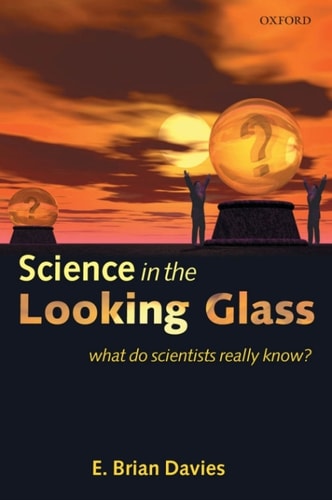
Science in the Looking Glass: What Do Scientists Really Know?
0
0
As an Amazon Associate and affiliate partner, Menrva Books earns from qualifying purchases. Learn more
Author Description
How do scientific conjectures become laws? Why does proof mean different things in different sciences? Do numbers exist, or were they invented? Why do some laws turn out to be wrong? In this wide-ranging book, Brian Davies discusses the basis for scientists' claims to knowledge about the world. He looks at science historically, emphasizing not only the achievements of scientists from Galileo onwards, but also their mistakes. He rejects the claim that all scientific knowledge is provisional, by citing examples from chemistry, biology and geology. A major feature of the book is its defence of the view that mathematics was invented rather than discovered. While experience has shown that disentangling knowledge from opinion and aspiration is a hard task, this book provides a clear guide to the difficulties. Full of illuminating examples and quotations, and with a scope ranging from psychology and evolution to quantum theory and mathematics, this book brings alive issues at the heart of all science.
Menrva's Summary
THE THESIS
This book investigates the foundational nature of scientific knowledge and the criteria by which scientific conjectures are elevated to the status of laws. E. Brian Davies, a mathematician, utilizes historical analysis and cross-disciplinary examples to challenge the notion that all scientific knowledge is merely provisional. He argues for a nuanced understanding of how scientists establish truth, specifically advocating for the perspective that mathematics is a human invention rather than an objective discovery.
THE SCOPE MAP
What You Will Find
- Historical analysis of scientific achievements and errors from Galileo to the present.
- Philosophical arguments regarding the ontological status of numbers and mathematical concepts.
- Comparative study of evidentiary standards across chemistry, biology, geology, and quantum theory.
Scope Limits
- The text does not provide a comprehensive history of every scientific discipline.
- It does not offer a technical manual for laboratory methodology or experimental design.
THE AUTHORITY PERSPECTIVE
Readers frequently note the academic density of the prose and the author's rigorous approach to philosophical inquiry. Experts highlight this as a valuable resource for those interested in the intersection of mathematics and the philosophy of science.
Page Count:
306
Publication Date:
2007-01-01
Publisher:
Oxford University Press
ISBN-10:
0191527432
ISBN-13:
9780191527432
Science
Philosophy
Mathematics
Epistemology
Science
Philosophy of
Science History
Community Tags
Similar Books