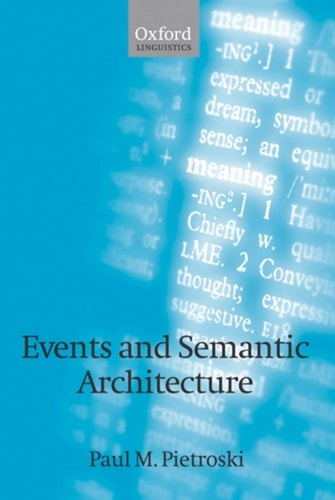
Events and Semantic Architecture
0
0
As an Amazon Associate and affiliate partner, Menrva Books earns from qualifying purchases. Learn more
Author Description
This book explores how grammatical structure is related to meaning. The meaning of a phrase clearly depends on its constituent words and how they are combined. But how does structure contribute to meaning in natural language? Does combining adjectives with nouns (as in 'brown dog') differ semantically from combining verbs with adverbs (as in 'barked loudly')? What is the significance of combining verbs with names and quantificational expressions (as in 'Fido chased every cat')? In addressing such questions, Paul Pietroski develops a novel conception of linguistic meaning according to which the semantic contribution of combining expressions is simple and uniform across constructions. Drawing on work at the heart of contemporary debates in linguistics and philosophy, the author argues that Donald Davidson's treatment of action sentences as event descriptions should be viewed as an instructive special case of a more general semantic theory. The unified theory covers a wide range of examples, including sentences that involve quantification, plurality, descriptions of complex causal processes, and verbs that take sentential complements. Professor Pietroski also provides fresh ways of thinking about much discussed semantic generalizations that seem to reflect innately determined aspects of human languages. Designed to be accessible to anyone with a basic knowledge of elementary logic, Events and Semantic Architecture will interest a wide range of scholars in linguistics, philosophy, and cognitive science.
Menrva's Summary
THE THESIS
How does grammatical structure contribute to the meaning of natural language expressions? Paul M. Pietroski, a professor of philosophy and linguistics, investigates the relationship between syntax and semantics by proposing a unified theory of meaning. He argues that the semantic contribution of combining expressions is uniform across various constructions, extending Donald Davidson's event-based approach to a broader range of linguistic phenomena.
THE SCOPE MAP
What You Will Find
- A unified semantic framework for action sentences, quantification, and plurality
- Analysis of verb-adverb and adjective-noun combinations
- Theoretical extensions of Davidsonian event semantics
- Discussion of innately determined aspects of human language
Scope Limits
- The text assumes the reader possesses a foundational understanding of elementary logic
- It does not provide an exhaustive survey of all non-Western linguistic structures
THE AUTHORITY PERSPECTIVE
Scholars in linguistics and philosophy frequently cite this work for its rigorous approach to semantic compositionality. Readers often note the academic density of the prose, which requires a solid background in formal logic to fully appreciate the author's arguments.
Page Count:
276
Publication Date:
2005-01-01
Publisher:
Oxford University Press
ISBN-10:
0191529559
ISBN-13:
9780191529559
Logic
Linguistics
Philosophy of
English
Act Philosophy
English & College Success
Semantics
Causation