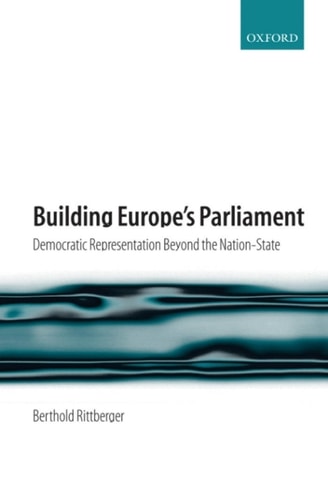
Building Europe's Parliament: Democratic Representation beyond the Nation State
0
0
As an Amazon Associate and affiliate partner, Menrva Books earns from qualifying purchases. Learn more
Author Description
Why have the national governments of EU member states successively endowed the European Parliament with supervisory, budgetary, and legislative powers over the past fifty years? Building Europe's Parliament sheds new light on this pivotal issue, and provides a major contribution to the study of the European Parliament. Rittberger develops a theory of delegation to representative institutions in international politics which combines elements of democratic theory and different strands of institutionalist theory. To test the plausibility of his theory, Rittberger draws on extensive archival material and offers theory-guided, in-depth case studies of three landmark decisions in the history of the European Parliament: the creation of the Common Assembly of the ECSC in 1951 and the concomitant acquisition of supervisory powers vis-à-vis the quasi-executive High Authority; the delegation of budgetary powers following the signing of the Treaty of Luxembourg in 1970; and the delegation of legislative powers resulting from the adoption of the Single European Act signed in 1986. This is followed by the charting of more recent key developments, culminating in the adoption of the Constitutional Treaty in 2004. The book provides a welcome addition to the literature on institutional design by reflecting on the conditions under which governments opt for the creation and empowerment of parliamentary institutions in international politics. It also makes a valuable contribution to the application of democratic theory to the study of the European Union by demonstrating that political elites shared the view that the new supranational polity which emerged from the debris of World War II suffered from 'democratic deficit' since its inception, thus disproving the claim that the lamented 'democratic deficit' is a recent phenomenon.
Menrva's Summary
THE THESIS
This book investigates why national governments within the European Union have consistently expanded the supervisory, budgetary, and legislative powers of the European Parliament over the last half-century. Berthold Rittberger, a scholar of international politics and European integration, constructs a theoretical framework that synthesizes democratic theory with institutionalist analysis. He argues that political elites recognized a 'democratic deficit' in the supranational structure following World War II, necessitating the empowerment of representative institutions to maintain legitimacy.
THE SCOPE MAP
What You Will Find
- A theoretical model of delegation to representative institutions in international politics.
- Analysis of the 1951 creation of the ECSC Common Assembly.
- Examination of the 1970 Treaty of Luxembourg regarding budgetary powers.
- Investigation of the 1986 Single European Act and the delegation of legislative authority.
- A historical overview of institutional development leading to the 2004 Constitutional Treaty.
Scope Limits
- The analysis focuses primarily on the motivations of national governments rather than the internal dynamics of the European Parliament itself.
- The study concludes its primary historical analysis at the 2004 Constitutional Treaty and does not cover subsequent institutional shifts.
THE AUTHORITY PERSPECTIVE
Scholars in the field of European integration identify this work as a rigorous application of institutionalist theory to the history of EU parliamentary development. Readers frequently note the academic density of the prose, which serves as a foundational text for understanding the origins of the democratic deficit in supranational governance.
Page Count:
256
Publication Date:
2005-01-01
Publisher:
Oxford University Press
ISBN-10:
0191534269
ISBN-13:
9780191534263
History
Comparative Politics
International relations
Democratic Theory
European Union
Community Tags
Similar Books