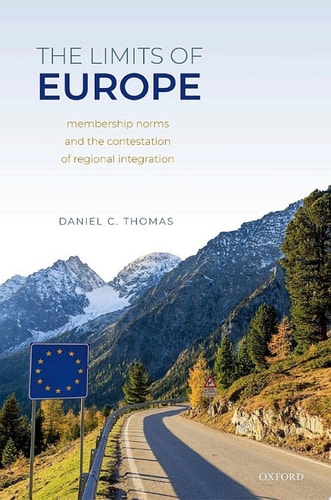
The Limits of Europe: Membership Norms and the Contestation of Regional Integration
0
0
As an Amazon Associate and affiliate partner, Menrva Books earns from qualifying purchases. Learn more
Author Description
Where does Europe begin and end? How have the European Union and its precursors decided which countries are eligible to join the community and which are not? Few issues are more hotly debated, more important for the course of European integration, or more consequential for individuals in and around the EU. As this book demonstrates, the limits of Europe are determined by the values shared at particular moments in time by the leaders of the community's member states, regardless of their particular policy preferences. These membership norms shape the community's decisions on enlargement by empowering certain political forces and disempowering others. And contrary to conventional wisdom, these norms have changed considerably over time. The Limits of Europe: Membership Norms and the Contestation of Regional Integration uses a novel combination of normative genealogy, statistical analysis and detailed tracing of EU decision-making on Greece, Spain, Turkey and Ukraine to demonstrate that changing membership norms have had a stronger impact on the community's enlargement since the 1950s than treaty rules, the location of the states seeking membership, or even the commercial or security interests of member states.
Menrva's Summary
THE THESIS
This book investigates how shifting membership norms, rather than strategic interests or treaty rules, have dictated the expansion and boundaries of the European Union since the 1950s. Daniel C. Thomas, a scholar of international relations, utilizes a framework of normative genealogy to analyze how shared values among member state leaders influence enlargement decisions. By examining the evolution of these norms, the author challenges the conventional wisdom that economic or security interests are the primary drivers of European integration.
THE SCOPE MAP
What You Will Find
- A longitudinal analysis of EU enlargement policy from the 1950s to the present.
- A methodological framework combining normative genealogy and statistical analysis.
- Detailed case studies focusing on the accession processes of Greece, Spain, Turkey, and Ukraine.
Scope Limits
- The text does not provide a comprehensive history of all EU member state accessions.
- The analysis focuses primarily on normative shifts rather than detailed economic impact assessments of integration.
THE AUTHORITY PERSPECTIVE
Experts recognize this work as a significant contribution to the study of European integration, particularly for its focus on the role of identity and values in political decision-making. Readers frequently note the academic density of the prose, which makes it a valuable resource for students and scholars of international relations and European politics.
Page Count:
284
Publication Date:
2021-01-01
Publisher:
OUP Oxford
ISBN-10:
0192667645
ISBN-13:
9780192667649
History
European Union
Comparative Politics
Sociology
International relations
Community Tags
Similar Books