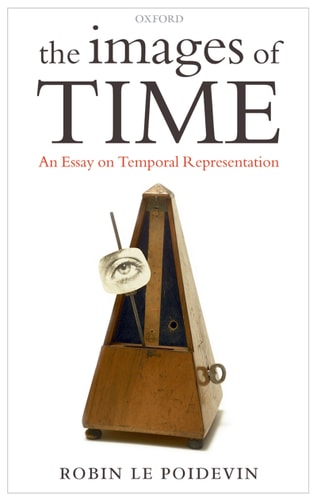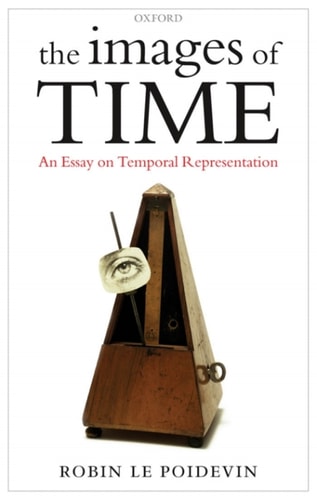
The Images of Time: An Essay on Temporal Representation
0
0
As an Amazon Associate and affiliate partner, Menrva Books earns from qualifying purchases. Learn more
Author Description
The Images of Time presents a philosophical investigation of the nature of time and the mind's ways of representing it. Robin Le Poidevin examines how we perceive time and change, the means by which memory links us with the past, the attempt to represent change and movement in art, and the nature of fictional time. These apparently disparate questions all concern the ways in which we represent aspects of time, in thought, experience, art and fiction. They also raise fundamental problems for our philosophical understanding, both of mental representation, and of the nature of time itself. Le Poidevin brings together issues in philosophy, psychology, aesthetics, and literary theory in examining the mechanisms underlying our representation of time in various media, and brings these to bear on metaphysical debates over the real nature of time. These debates concern which aspects of time are genuinely part of time's intrinsic nature, and which, in some sense, are mind-dependent. Arguably, the most important debate concerns time's passage: does time pass in reality, or is the division of events into past, present, and future simply a reflection of our temporal perspective - a result of the interaction between a 'static' world and minds capable of representing it? Le Poidevin argues that, contrary to what perception and memory lead us to suppose, time does not really pass, and this surprising conclusion can be reconciled with the characteristic features of temporal experience.
Menrva's Summary
THE THESIS
Does time possess an objective, intrinsic passage, or is the experience of temporal flow a construct of the human mind? Professor Robin Le Poidevin, a scholar specializing in the philosophy of time, synthesizes insights from psychology, aesthetics, and literary theory to investigate how humans represent temporal phenomena. He evaluates the tension between our subjective experience of change and the metaphysical possibility of a static, block-universe reality. The author argues that the passage of time is not an objective feature of the physical world but rather a product of our cognitive interaction with it.
THE SCOPE MAP
What You Will Find
- Analysis of mental representation in memory and perception
- Examination of temporal depiction in art, movement, and literature
- Metaphysical arguments regarding the B-theory of time
- Synthesis of cognitive psychology and philosophical inquiry
Scope Limits
- Does not provide a comprehensive history of physics or relativity
- Does not focus on the practical application of time-keeping technologies
THE AUTHORITY PERSPECTIVE
Experts recognize this work as a sophisticated interdisciplinary bridge between analytic metaphysics and the philosophy of perception. Readers frequently note the academic density of the prose, which requires a foundational understanding of contemporary philosophical debates regarding temporal ontology.
Page Count:
192
Publication Date:
2007-01-01
Publisher:
Oxford University Press
ISBN-10:
0191532762
ISBN-13:
9780191532764
Philosophy
Time
Methodology
Aesthetics
Philosophy of
Metaphysics