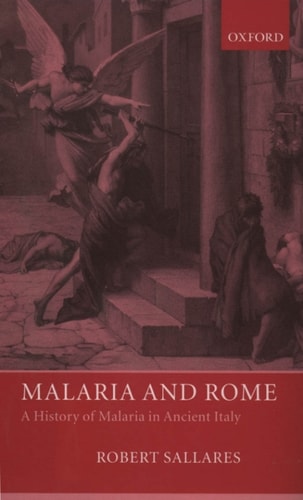
Malaria and Rome: A History of Malaria in Ancient Italy
0
0
As an Amazon Associate and affiliate partner, Menrva Books earns from qualifying purchases. Learn more
Author Description
Malaria and Rome is the first comprehensive study of malaria in ancient Italy since the research of the distinguished Italian malariologist Angelo Celli in the early twentieth century. It demonstrates the importance of disease patterns and history in understanding the demography of ancient populations. Robert Sallares argues that malaria became increasingly prevalent in Roman times in central Italy as a result of ecological change and alterations to the physical landscape such as deforestation. Making full use of contemporary sources and comparative material from other periods, he shows that malaria had a significant effect on mortality rates in certain regions of Roman Italy. Robert Sallares incorporates all the important advances made in many relevant fields since Celli's time. These include recent geomorphological research on the evolution of the coastal environments of Italy that were notorious for malaria in the past, biomolecular research on the evolution of malaria, ancient DNA as a new source of evidence for malaria in antiquity, the differentiation of mosquito species that permits understanding of the phenomenon of anophelism without malaria (where the climate is optimal for malaria and Anopheles mosquitoes are present, but there is no malaria), and recent medical research on the interactions between malaria and other diseases. The argument develops with a careful interplay between the modern microbiology of the disease and the Greek and Latin literary texts. Both contemporary sources and comparative material from other periods are used to interpret the ancient sources. In addition to the medical and demographic effects on the Roman population, Malaria and Rome considers the social and economic effects of malaria, for example on settlement patterns and on agricultural systems. Robert Sallares also examines the varied human responses to and interpretations of malaria in antiquity, ranging from the attempts at rational understanding made by the Hippocratic au
Menrva's Summary
THE THESIS
This book investigates the historical prevalence and impact of malaria on the demography, economy, and social structures of ancient Italy. Robert Sallares, a scholar specializing in the intersection of history and biology, synthesizes modern microbiological data with classical literary sources to argue that ecological shifts, such as deforestation, facilitated the spread of the disease. He posits that malaria was a critical, often overlooked factor in the mortality rates and settlement patterns of the Roman world.
THE SCOPE MAP
What You Will Find
- Analysis of geomorphological changes in Italian coastal environments
- Integration of biomolecular research and ancient DNA evidence
- Examination of the interaction between malaria and other historical diseases
- Comparative analysis of Greek and Latin literary texts regarding health
Scope Limits
- The study focuses primarily on central Italy rather than the entirety of the Roman Empire
- The work does not provide a comprehensive medical history of all infectious diseases in antiquity
THE AUTHORITY PERSPECTIVE
Experts recognize this work as a significant advancement in the field of historical epidemiology, successfully bridging the gap between classical studies and modern medical science. Readers frequently note the academic density of the prose, which requires a foundational understanding of both Roman history and biological concepts to fully appreciate the author's arguments.
Page Count:
360
Publication Date:
2002-01-01
Publisher:
Oxford University Press
ISBN-10:
0191530212
ISBN-13:
9780191530210
History
Epidemiology
Roman History
Ancient History
Environmental History
Malaria
Italy history
MEDICAL History
Community Tags
Similar Books