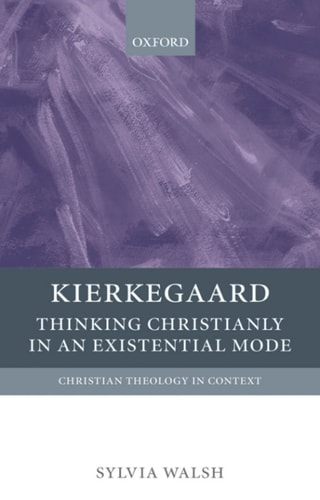
Kierkegaard: Thinking Christianly in an Existential Mode
0
0
As an Amazon Associate and affiliate partner, Menrva Books earns from qualifying purchases. Learn more
Author Description
Søren Kierkegaard (1813-1855) was first and foremost a Christian thinker who is perhaps best known for his devastating attack upon Christendom or the established order of his time. Not since Luther has there been a Protestant thinker who has so uncompromisingly sought to define and present Christianity in its utmost integrity. Characterizing Christianity as an 'existence-communication' rather than a doctrine, Kierkegaard sought to portray what it means to be a Christian in the strictest sense in the interest of reintroducing authentic Christianity as an existential possibility for every individual in the modern age. Sylvia Walsh explores Kierkegaard's understanding of Christianity and the existential mode of thinking theologically appropriate to it in the context of the intellectual, cultural, and socio-political milieu of his time. She contrasts his approach with objective ways of doing theology which in his view falsify Christianity and the believer's relation to it. The study begins with a biographical overview of the personal and intellectual influences, theological upbringing, important events, and phases of authorship in Kierkegaard's life. Walsh highlights some of his most important contributions to Christian thought concerning the Christian understanding of God; our human condition in anxiety, sin, and despair and the task of becoming a self before God; Christ as the absolute paradox, redeemer, and prototype; the Christian life of faith, hope, and love; and the relation of religion, culture, and society.
Menrva's Summary
THE THESIS
This study investigates how Søren Kierkegaard formulated a theology of existence that challenged the established Christian order of the nineteenth century. Sylvia Walsh, a scholar specializing in Kierkegaardian thought, utilizes a biographical and thematic framework to analyze how Kierkegaard rejected objective, doctrinal theology in favor of an existential approach. She argues that his work serves as a rigorous attempt to reintroduce authentic Christianity as a lived reality for the individual, rather than a mere set of abstract propositions.
THE SCOPE MAP
What You Will Find
- A comprehensive biographical overview of Kierkegaard's intellectual and personal development.
- An analysis of key theological concepts including anxiety, sin, despair, and the paradox of Christ.
- A comparative study between Kierkegaard's existential communication and objective theological methods.
Scope Limits
- The text focuses primarily on Kierkegaard's theological contributions rather than a comprehensive critique of his entire literary output.
- The analysis is situated within the specific socio-political context of nineteenth-century Denmark and may not address modern secular applications of his philosophy.
THE AUTHORITY PERSPECTIVE
Scholars and students of philosophy frequently cite this work as a clear and accessible entry point into the complexities of Kierkegaard's theological project. Experts highlight the text for its balanced integration of biographical detail with rigorous conceptual analysis of existential themes.
Page Count:
248
Publication Date:
2009-01-01
Publisher:
Oxford University Press
ISBN-10:
0191549045
ISBN-13:
9780191549045
Religion
Biography
Philosophy
Christianity
Christian Theology
Existentialism
Intellectual History
Community Tags
Similar Books