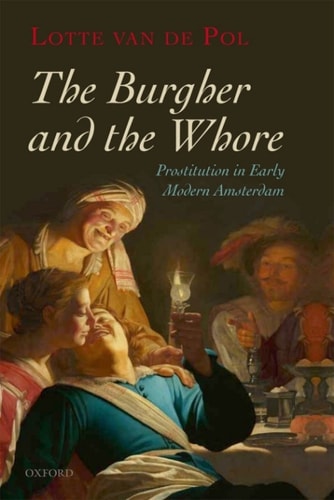
The Burgher and the Whore: Prostitution in Early Modern Amsterdam
0
0
As an Amazon Associate and affiliate partner, Menrva Books earns from qualifying purchases. Learn more
Author Description
Amsterdam was, after London and Paris, the third largest city in early modern Europe, and was renowned throughout Europe for its widespread and visible prostitution. Delving deep into a wide range of sources, but making particular use of the transcripts of thousands of trials, The Burgher and the Whore reconstructs Amsterdam's whoredom in detail. The colourful and fascinating descriptions of the prostitutes, their bawds, their clients, and the police shed new light on the cultural, social, and economic conditions of the lives of poor women in a seafaring society. Lotte van de Pol explores how the vice trade was embedded in Amsterdam's society, economy, and judicial system, and how legislation and policing were shaped by misogynist attitudes towards women and fear of God's wrath and venereal diseases towards sex. The story concentrates on the people living at the margins of a rich metropolis, in which there was a large surplus of women, many of them poor immigrants with little prospect of marriage. Many changes are visible in the 150 years under scrutiny, including the view of prostitution from immorality to trade, and of prostitutes from whores and criminals to paupers. The result is a book that can be read as the history of the Dutch Golden Age from below.
Menrva's Summary
THE THESIS
This work investigates how prostitution functioned as an integrated component of the social, economic, and judicial landscape in early modern Amsterdam. Lotte van de Pol, a historian specializing in the social history of the Dutch Golden Age, utilizes extensive judicial trial transcripts and archival records to reconstruct the lives of sex workers. She argues that the regulation of the vice trade was driven by a complex interplay of misogynistic social attitudes, economic necessity for immigrant women, and shifting moral frameworks regarding public health and religion.
THE SCOPE MAP
What You Will Find
- Analysis of 150 years of judicial records and trial transcripts from Amsterdam.
- Examination of the economic conditions for poor, immigrant women in a seafaring metropolis.
- Investigation into the evolution of legal attitudes toward prostitution from criminalization to social management.
Scope Limits
- The study is geographically confined to Amsterdam and does not provide a comparative analysis of other European cities.
- The narrative focuses primarily on the lower social strata and does not extensively cover the perspectives of the political elite beyond their legislative actions.
THE AUTHORITY PERSPECTIVE
Historians and scholars of the Dutch Golden Age frequently cite this work as a foundational text for understanding the intersection of gender, poverty, and urban regulation. Readers often note the academic density of the prose, which relies heavily on primary source documentation to provide a rigorous social history of the period.
Page Count:
288
Publication Date:
2011-01-01
Publisher:
Oxford University Press
ISBN-10:
0191549495
ISBN-13:
9780191549496
History
Gender Studies
Social History
European History
Sociology
Woman Studies
Dutch History
Poor
Community Tags
Similar Books