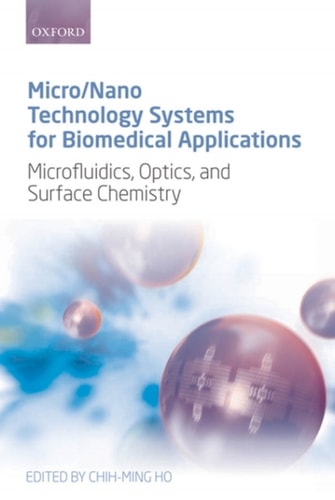
Micro/Nano Technology Systems for Biomedical Applications: Microfluidics, Optics, and Surface Chemistry
0
0
As an Amazon Associate and affiliate partner, Menrva Books earns from qualifying purchases. Learn more
Author Description
In daily life, we are accustomed to working with length scales of feet or meters, but the building blocks from which our bodies are constructed are many orders of magnitude smaller. The technologies that are being developed to intervene at these minute scales have the potential to improve human health and significantly enrich our lives. Revolutionary micro/nano technology platforms have led to dramatic advances in sample preparation, analysis and cell culture. From the 1990s through to the very beginning of the twenty-first century, the focus was on the development of manufacturing technologies. Through elegant design and sophisticated fabrication, the micro- to nano-scale manipulation of fluids and particles has become routine. Since then, it has become possible to control molecular interactions at device surfaces, and optical manipulation, imaging and sensing techniques can also be incorporated. Micro/nano technology platforms are already being used to study and direct biological processes at the cellular and sub-cellular level, and to detect disease with greater sensitivity and specificity. The challenges and excitement in the near future will be in engineering these sophisticated, multifunctional devices to seamlessly interface with complex biological systems. Providing a clear guide that moves from molecules through devices to systems, this book reviews fundamental aspects of microfluidic devices, including fabrication, surface property control, pressure-driven and electrokinetic flow, and functions such as fluid mixing, particle sorting and molecular separations. The integration of optical and plasmonic imaging, optoelectronic tweezers for single particle manipulation, and optical and electrical signal transduction methods for biosensing are shown to provide extraordinary capabilities for bioanalytical and biomedical applications. These represent key areas of research that will lead to the next generation of micro/nano-based systems. Anyone working in this fas
Menrva's Summary
THE THESIS
This text investigates the integration of micro- and nano-scale technologies into multifunctional devices capable of interfacing with complex biological systems for advanced medical diagnostics and analysis. Author Chih-Ming Ho, a prominent researcher in the field of micro-electro-mechanical systems (MEMS), synthesizes decades of progress in fabrication and molecular control. The book argues that the convergence of microfluidics, surface chemistry, and optical sensing is the primary driver for the next generation of high-sensitivity bioanalytical tools.
THE SCOPE MAP
What You Will Find
- Fabrication techniques for microfluidic and nano-scale devices
- Mechanisms for pressure-driven and electrokinetic fluid flow
- Methods for surface property control and molecular interaction management
- Integration of optical, plasmonic, and optoelectronic sensing technologies
Scope Limits
- Does not provide exhaustive clinical trial data for specific commercial medical products
- Focuses primarily on engineering and physical principles rather than systemic biological modeling
THE AUTHORITY PERSPECTIVE
Experts recognize this work as a technical synthesis of the physical principles governing micro-scale biomedical devices. Readers frequently note the high level of technical density, making it a suitable reference for graduate-level researchers and engineers in the field of bio-MEMS.
Page Count:
496
Publication Date:
2010-01-01
Publisher:
Oxford University Press
ISBN-10:
0191551384
ISBN-13:
9780191551383
English & College Success
Surface Chemistry
Microfluidics
Nanotechnology
Applied Physics
Biomedical Engineering
Biotechnology
Earth Sciences
English
Linguistics
Nanoscience
Community Tags
Similar Books