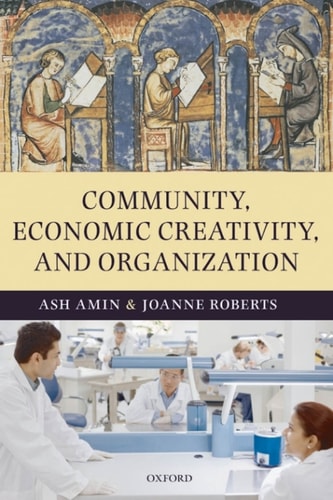
Community, Economic Creativity, and Organization
0
0
As an Amazon Associate and affiliate partner, Menrva Books earns from qualifying purchases. Learn more
Author Description
It has long been an interest of researchers in economics, sociology, organization studies, and economic geography to understand how firms innovate. Most recently, this interest has begun to examine the micro-processes of work and organization that sustain social creativity, emphasizing the learning and knowing through action when social actors and technologies come together in 'communities of practice'; everyday interactions of common purpose and mutual obligation. These communities are said to spark both incremental and radical innovation. In the book, leading international scholars critically examine the concept of communities of practice and its applications in different spatial, organizational, and creative settings. Chapters examine the development of the concept, the link between situated practice and different types of creative outcome, the interface between spatial and relational proximity, and the organizational demands of learning and knowing through communities of practice. More widely, the chapters examine the compatibility between markets, knowledge capitalism, and community; seemingly in conflict with each other, but discursively not. Exploring the frontiers of current understanding of situated knowing and learning, this book is for all those interested in the economic sociology of organizational creativity and knowledge capitalism in general.
Menrva's Summary
THE THESIS
This book investigates the relationship between social communities of practice and the generation of economic innovation within organizational settings. Editors Ash Amin and Joanne Roberts compile contributions from international scholars to analyze how micro-processes of work, social interaction, and shared purpose facilitate learning and knowledge creation. The text evaluates whether the collaborative nature of these communities remains compatible with the competitive demands of knowledge capitalism and market-driven environments.
THE SCOPE MAP
What You Will Find
- Theoretical development of the communities of practice concept
- Analysis of the interface between spatial and relational proximity
- Examination of organizational requirements for situated learning
- Critical assessment of the tension between market competition and social collaboration
Scope Limits
- The text focuses primarily on organizational and economic sociology perspectives rather than purely technical or engineering-based innovation models
- It does not provide a prescriptive manual for corporate management but rather a scholarly critique of existing frameworks
THE AUTHORITY PERSPECTIVE
Scholars and researchers in economic geography and organizational studies frequently cite this work for its rigorous examination of the intersection between social theory and firm-level innovation. Readers often note the academic density of the prose, which is intended for an audience familiar with the discourse surrounding knowledge capitalism and economic sociology.
Page Count:
320
Publication Date:
2008-01-01
Publisher:
Oxford University Press
ISBN-10:
0191562815
ISBN-13:
9780191562815
Economics
Social Groups
Special Topics
Economic Geography
Management Theory
Sociology
Organizational Learning