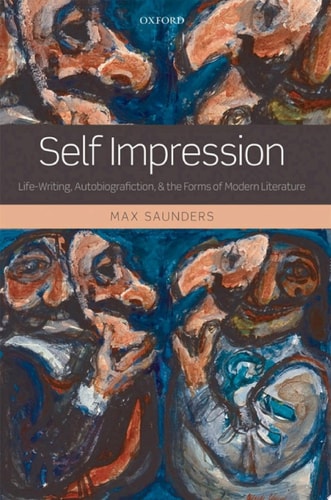
Self Impression: Life-Writing, Autobiografiction, and the Forms of Modern Literature
0
0
As an Amazon Associate and affiliate partner, Menrva Books earns from qualifying purchases. Learn more
Author Description
I am aware that, once my pen intervenes, I can make whatever I like out of what I was.' Paul Valéry, Moi. Modernism is often characterized as a movement of impersonality; a rejection of auto/biography. But most of the major works of European modernism and postmodernism engage in very profound and central ways with questions about life-writing. Max Saunders explores the ways in which modern writers from the 1870s to the 1930s experimented with forms of life-writing - biography, autobiography, memoir, diary, journal - increasingly for the purposes of fiction. He identifies a wave of new hybrid forms from the late nineteenth century and uses the term 'autobiografiction' - discovered in a surprisingly early essay of 1906 - to provide a fresh perspective on turn-of-the-century literature, and to propose a radically new literary history of Modernism. Saunders offers a taxonomy of the extraordinary variety of experiments with life-writing, demonstrating how they arose in the nineteenth century as the pressures of secularization and psychological theory disturbed the categories of biography and autobiography, in works by authors such as Pater, Ruskin, Proust, 'Mark Rutherford', George Gissing, and A. C. Benson. He goes on to look at writers experimenting further with autobiografiction as Impressionism turns into Modernism, juxtaposing detailed and vivacious readings of key Modernist texts by Joyce, Stein, Pound, and Woolf, with explorations of the work of other authors - including H. G. Wells, Henry James, Joseph Conrad, Ford Madox Ford, and Wyndham Lewis - whose experiments with life-writing forms are no less striking. The book concludes with a consideration of the afterlife of these fascinating experiments in the postmodern literature of Nabokov, Lessing, and Byatt. Self Impression sheds light on a number of significant but under-theorized issues; the meanings of 'autobiographical', the generic implications of literary autobiography, and the intriguing relation between au
Menrva's Summary
THE THESIS
This work investigates the evolution of life-writing forms and the emergence of 'autobiografiction' as a central, yet under-theorized, component of Modernist literature. Max Saunders, a scholar of English literature, utilizes a historical and formalist framework to argue that the rigid boundaries between biography, autobiography, and fiction dissolved under the pressures of secularization and psychological theory. By analyzing a wide array of texts from the 1870s to the postmodern era, he demonstrates how writers manipulated these forms to create hybrid narratives that challenge traditional notions of self-representation.
THE SCOPE MAP
What You Will Find
- A taxonomy of hybrid life-writing forms including memoir, diary, and journal entries.
- Detailed literary analysis of authors such as Pater, Ruskin, Proust, Joyce, Stein, Pound, and Woolf.
- A historical survey of literary shifts from the late nineteenth century through the postmodern period.
Scope Limits
- The study focuses primarily on European and British Modernist traditions.
- It does not provide an exhaustive biography of the authors mentioned, but rather focuses on their formal experiments with self-representation.
THE AUTHORITY PERSPECTIVE
Scholars and critics recognize this text as a significant contribution to the study of Modernist formal innovation and the history of the autobiographical genre. Readers frequently note the academic density of the prose, which provides a rigorous framework for understanding the complex intersection of fiction and life-writing.
Page Count:
588
Publication Date:
2010-01-01
Publisher:
OUP Oxford
ISBN-10:
0191614734
ISBN-13:
9780191614736
Biography
Autobiography
Literature History
English
Autobiographical fiction
Literary Form
Literary theory
Modernism
English & College Success
Literary Criticism
Community Tags
Other Editions(2)
Similar Books

Reader Comments
Share Your Thoughts
No comments yet. Be the first to share your thoughts!