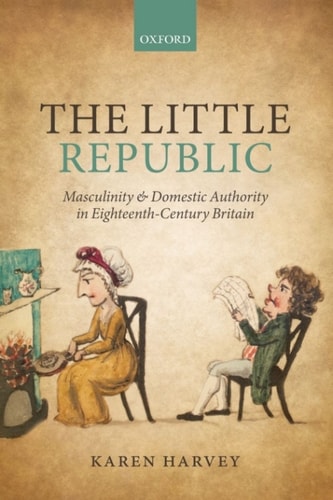
Little Republic: Men and the House in Eighteenth-Century Britain
0
0
As an Amazon Associate and affiliate partner, Menrva Books earns from qualifying purchases. Learn more
Author Description
This is an open access title available under the terms of a CC BY-NC-ND 3.0 International licence. It is free to read at Oxford Scholarship Online and offered as a free PDF download from OUP and selected open access locations. The Little Republic examines the relationship between masculinity, the household, and domestic patriarchy. How did men engage with domestic life? What did the household mean to men? How could they lay claim to domestic authority? In reconstructing men's own understandings, this volume foregrounds the concept of the 'house' and the associated discourse of 'oeconomy': the practice of managing the economic and moral resources of the household for the maintenance of good order. Oeconomy shaped men's engagements with the household adn underpinned the patriarchal authority they acquired through the mundane material practices of everyday household management. The house also endured as a central component of masculinity, providing the grounding for men's self and public identities. Indeed, the skills and virtues practised by men in their 'little republics' were tied increasingly closely to a language of public-spirited political citizenship. The close relationship between men and the domestic in eighteenth-century Britain has been obscured by accounts that chart a decline in domestic patriarchy grounded in political patriarchalism, and the emergence of a new 'home' charcterized by a feminized culture of 'domesticity'. The Little Republic shifts the terms of these discussions. The eighteenth-century house was neither private nor feminized. Oeconomy brought together the house and the world - and increasingly so - primarily through men's authoritative engagement with the household.
Menrva's Summary
THE THESIS
How did men in eighteenth-century Britain construct their identities and exercise authority through the management of the domestic household? Karen Harvey, a historian specializing in gender and material culture, utilizes primary source documents and household records to argue that the domestic sphere was not a feminized private space, but rather a site of masculine authority and political practice. She posits that the concept of 'oeconomy'—the active management of household resources—served as a foundational skill for men, linking their private domestic roles to their public identities as citizens.
THE SCOPE MAP
What You Will Find
- Analysis of eighteenth-century household management practices
- Examination of the discourse surrounding 'oeconomy' and domestic patriarchy
- Historical investigation into the intersection of masculinity and domestic space
- Primary source evidence from personal papers and household accounts
Scope Limits
- The study is geographically restricted to Britain
- The analysis focuses primarily on the eighteenth century and does not track long-term shifts into the Victorian era
THE AUTHORITY PERSPECTIVE
Historians and gender scholars frequently cite this work for its challenge to the traditional narrative of the feminized domestic sphere. Experts highlight the text as a significant contribution to the study of masculinity, noting its rigorous use of archival material to redefine the historical understanding of the eighteenth-century home.
Page Count:
336
Publication Date:
2012-01-01
Publisher:
Oxford University Press
ISBN-10:
0191612375
ISBN-13:
9780191612374
History
Eighteenth Century
Gender Studies
Social History
British History
Cultural History
Community Tags
Similar Books