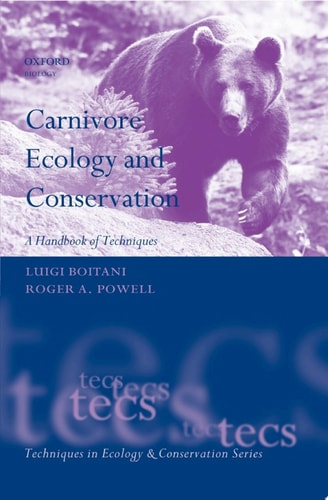
Carnivore Ecology and Conservation: A Handbook of Techniques
0
0
As an Amazon Associate and affiliate partner, Menrva Books earns from qualifying purchases. Learn more
Author Description
Animals that must hunt and kill for at least part of their living are inherently interesting to many people and the role that carnivores play in biological communities attract interest from ecologists and conservation biologists. Conflicts with human activities stimulate continual debates about the management of carnivore populations, and throughout the world people seek workable solutions for human/carnivore coexistence. This concise yet authoritative handbook describes research methods and techniques for the study and conservation of all terrestrial carnivore species. Particular attention is paid to techniques for managing the human/carnivore interface. Descriptions of the latest methodologies are supported by references to case studies, whilst dedicated boxes are used to illustrate how a technique is applied to a specific land cover type, species, or particular socio-economic context. The book describes the most recent advances in modelling the patterns of animal distributions, movements, and use of land cover types, as well as including the most efficient methods to trap, handle, and mark carnivores. Carnivores are biogeographically diverse and whilst extensive scientific research has investigated many aspects of carnivore biology, not all species have been equally covered. This book is unique in its intention to provide practical guidance for carrying out research and conservation of carnivores across all species and areas of the world.
Menrva's Summary
THE THESIS
This handbook investigates the methodological challenges and practical requirements for studying and conserving terrestrial carnivore species globally. Editors Luigi Boitani and Roger A. Powell compile contributions from field experts to establish a standardized framework for research. The text addresses the dual necessity of gathering biological data while navigating the complex socio-economic realities of human-carnivore coexistence.
THE SCOPE MAP
What You Will Find
- Methodologies for trapping, handling, and marking diverse carnivore species
- Statistical models for analyzing animal distribution, movement, and habitat utilization
- Case studies illustrating the application of research techniques in specific environments
- Strategies for mitigating conflict at the human-carnivore interface
Scope Limits
- The text focuses exclusively on terrestrial carnivores and does not cover marine species
- It provides technical research guidance rather than general natural history or species-specific biology
THE AUTHORITY PERSPECTIVE
Experts recognize this volume as a standard reference for field biologists and conservation practitioners working with predatory mammals. Readers frequently note the technical density of the prose, which serves as a practical manual for designing and executing rigorous wildlife studies.
Page Count:
544
Publication Date:
2012-01-01
Publisher:
OUP Oxford
ISBN-10:
0191625345
ISBN-13:
9780191625343
Science
Zoology
Conservation Biology
Animal ecology
Ecology