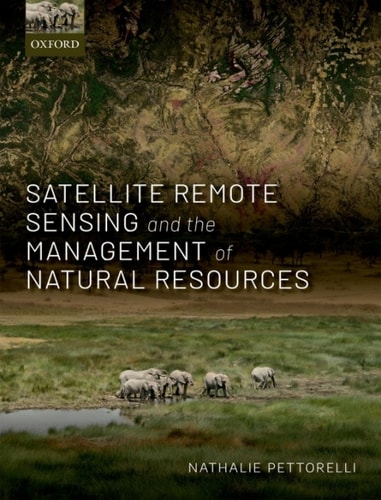
Satellite Remote Sensing and the Management of Natural Resources
0
0
As an Amazon Associate and affiliate partner, Menrva Books earns from qualifying purchases. Learn more
Author Description
The ability to anticipate the impacts of global environmental changes on natural resources is fundamental to designing appropriate and optimised adaptation and mitigation strategies. However, this requires the scientific community to have access to reliable, large-scale information on spatio-temporal changes in the distribution of abiotic conditions and on the distribution, structure, composition, and functioning of ecosystems. Satellite remote sensing can provide access to some of this fundamental data by offering repeatable, standardised, and verifiable information that is directly relevant to the monitoring and management of our natural capital. This book demonstrates how ecological knowledge and satellite-based information can be effectively combined to address a wide array of current natural resource management needs. By focusing on concrete applied examples in both the marine and terrestrial realms, it will help pave the way for developing enhanced levels of collaboration between the ecological and remote sensing communities, as well as shaping their future research directions. Satellite Remote Sensing and the Management of Natural Resources is primarily aimed at ecologists and remote sensing specialists, as well as policy makers and practitioners in the fields of conservation biology, biodiversity monitoring, and natural resource management.
Menrva's Summary
THE THESIS
This book investigates how the integration of satellite remote sensing data with ecological knowledge can improve the monitoring and management of natural resources in a changing global environment. Nathalie Pettorelli, a researcher specializing in biodiversity and remote sensing, synthesizes current methodologies to bridge the gap between technical data acquisition and practical conservation application. The text argues that standardized, large-scale satellite observations are essential for developing effective adaptation and mitigation strategies for both marine and terrestrial ecosystems.
THE SCOPE MAP
What You Will Find
- Methodologies for combining ecological theory with satellite-derived spatio-temporal data
- Applied case studies covering diverse marine and terrestrial environments
- Frameworks for interdisciplinary collaboration between ecologists and remote sensing specialists
Scope Limits
- Does not provide an exhaustive technical manual for specific satellite hardware or software programming
- Does not cover localized, small-scale ecological monitoring that cannot be captured by satellite resolution
THE AUTHORITY PERSPECTIVE
Experts identify this work as a bridge between the fields of ecology and remote sensing, noting its utility for practitioners and policy makers. Readers frequently highlight the book's focus on applied, real-world examples as a primary strength for those working in conservation biology.
Page Count:
224
Publication Date:
2019-01-01
Publisher:
OUP Oxford
ISBN-10:
0191026794
ISBN-13:
9780191026799
Science
Ecology
Technology & Engineering
Trades & Technology
Remote sensing
Information Systems
Conservation Biology