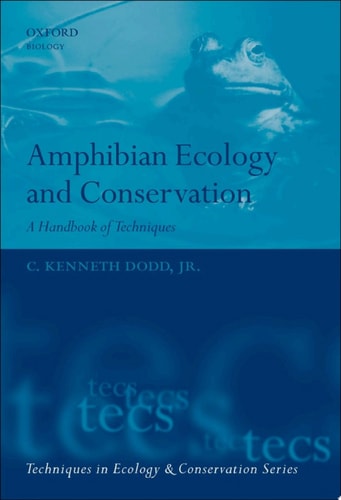
Amphibian Ecology and Conservation: A Handbook of Techniques
0
0
As an Amazon Associate and affiliate partner, Menrva Books earns from qualifying purchases. Learn more
Author Description
This practical manual of amphibian ecology and conservation brings together a distinguished, international group of amphibian researchers to provide a state-of-the-art review of the many new and exciting techniques used to study amphibians and to track their conservation status and population trends. The integration of ecology and conservation is a natural outcome of the types of questions posed by these disciplines: how amphibians can and should be sampled, marked, and followed through time; how abundance and population trends are measured; what are the robust statistical methods that can be used in ecology and conservation; what roles do amphibians play in community structure and function; how do animals function in their environment; and what affects the long-term persistence of species assemblages? Although emphasizing field ecology, sections on physiological ecology, genetics, landscape ecology, and disease analysis are also included. The book describes the latest statistical approaches in amphibian field ecology and conservation, as well as the use of models in interpreting field research. Much of this information is scattered in the scientific literature or not readily available, and the intention is to provide an affordable, comprehensive synthesis for use by graduate students, researchers, and practising conservationists worldwide.
Menrva's Summary
THE THESIS
How can researchers effectively standardize the study of amphibian populations to better inform global conservation strategies? C. Kenneth Dodd Jr. compiles contributions from an international cohort of experts to synthesize current methodologies in amphibian research. The text addresses the necessity of integrating ecological data with conservation practices to understand species persistence, population dynamics, and environmental interactions. It serves as a comprehensive reference for applying rigorous statistical and field-based techniques to the study of amphibians.
THE SCOPE MAP
What You Will Find
- Methodologies for sampling, marking, and monitoring amphibian populations over time
- Statistical frameworks for interpreting abundance and population trends
- Specialized sections on physiological ecology, genetics, landscape ecology, and disease analysis
- Modeling techniques for interpreting field research data
Scope Limits
- The text focuses primarily on field ecology and may not provide exhaustive coverage of captive breeding or laboratory-only husbandry techniques
- It assumes a baseline level of statistical and biological knowledge suitable for graduate-level study
THE AUTHORITY PERSPECTIVE
Experts recognize this handbook as a primary resource for standardizing research practices across the field of herpetology. Readers frequently note the technical density of the prose, which makes it a standard reference for graduate students and professional conservationists.
Page Count:
556
Publication Date:
2009-01-01
Publisher:
OUP Oxford
ISBN-10:
0191037389
ISBN-13:
9780191037382
Science
Field Research
Ecology
Zoology
Amphibians
Conservation Biology
Nature
Earth Sciences
Community Tags
Similar Books