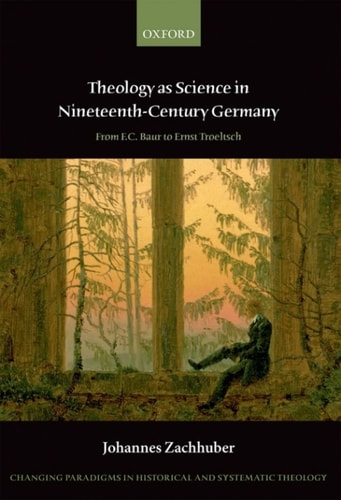
Theology as Science in Nineteenth-Century Germany: From F.C. Baur to Ernst Troeltsch
0
0
As an Amazon Associate and affiliate partner, Menrva Books earns from qualifying purchases. Learn more
Author Description
This study describes the origin, development and crisis of the German nineteenth-century project of theology as science. Its narrative is focused on the two predominant theological schools during this period, the Tübingen School and the Ritschl School. Their work emerges as a grand attempt to synthesize historical and systematic theology within the twin paradigms of historicism and German Idealism. Engaging in detail with the theological, historical and philosophical scholarship of the story's protagonists, Johannes Zachhuber reconstructs the basis of this scholarship as a deep belief in the eventual unity of human knowledge. This idealism clashed with the historicist principles underlying much of the scholars' actual research. The tension between these paradigms ran through the entire period and ultimately led to the disintegration of the project at the end of the century. Drawing on a wealth of primary sources, many of which have never been used in English speaking scholarship before, Zachhuber embeds the essentially theological story he presents within broader intellectual developments in nineteenth century Germany. In spite of its eventual failure, the project of theology as science in nineteenth century Germany is here described as a paradigmatic intellectual endeavour of European modernity with far-reaching significance beyond the confines of a single academic discipline.
Menrva's Summary
THE THESIS
This study investigates the rise, evolution, and eventual collapse of the nineteenth-century German academic project to establish theology as a rigorous scientific discipline. Johannes Zachhuber, a scholar of historical and systematic theology, examines how theologians attempted to reconcile the conflicting demands of German Idealism and historicism. By analyzing the work of the Tübingen and Ritschl schools, the author demonstrates how the pursuit of a unified theory of human knowledge ultimately disintegrated under the weight of its own internal contradictions.
THE SCOPE MAP
What You Will Find
- Detailed analysis of the Tübingen School and the Ritschl School.
- Examination of the intersection between German Idealism and historicist research methodologies.
- Extensive use of primary source material previously unavailable in English-language scholarship.
Scope Limits
- The study focuses primarily on the German academic context and does not provide a comprehensive survey of theology in other European nations during the same period.
THE AUTHORITY PERSPECTIVE
Experts recognize this work as a significant contribution to the history of ideas, noting its meticulous use of primary sources to clarify complex intellectual shifts. Readers frequently observe the high level of academic density, making it a specialized resource for scholars of theology and nineteenth-century intellectual history.
Page Count:
336
Publication Date:
2013-01-01
Publisher:
OUP Oxford
ISBN-10:
0191626708
ISBN-13:
9780191626708
Religion
Nineteenth century
Intellectual History
Theology
Academic Theology
Philosophy history
Community Tags
Similar Books