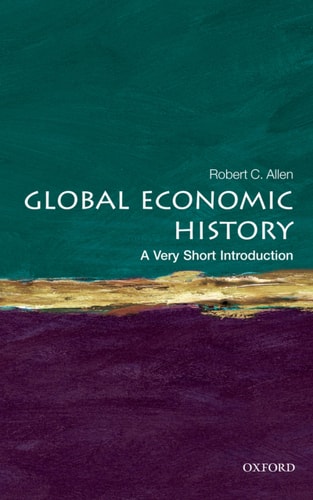
Global Economic History: A Very Short Introduction
0
0
As an Amazon Associate and affiliate partner, Menrva Books earns from qualifying purchases. Learn more
Author Description
Why are some countries rich and others poor? In 1500, global income differences were small, but disparities have grown dramatically since Columbus reached America. In this Very Short Introduction, Robert C. Allen shows how the interplay of geography, globalization, technological change, and economic policy has determined the wealth and poverty of nations. Allen shows how the industrial revolution was Britain's path-breaking response to the challenge of globalization. Western Europe and North America joined Britain to form a club of rich nations, pursuing four polices--creating a national market by abolishing internal tariffs and investing in transportation, erecting an external tariff to protect their fledgling industries from British competition, creating banks to stabilize the currency and mobilize domestic savings for investment, and promoting mass education to prepare people for industrial work. Together these countries pioneered new technologies that have made them ever richer. A few countries--Japan, Soviet Russia, South Korea, Taiwan, and perhaps China--have caught up with the West through creative responses to the technological challenge and with Big Push industrialization that has achieved rapid growth through coordinated investment.
Menrva's Summary
THE THESIS
This book investigates the historical drivers of global income inequality and the mechanisms that have allowed certain nations to achieve prosperity while others remain impoverished. Robert C. Allen, a professor of economic history, utilizes a comparative framework to analyze the divergence in national wealth since 1500. He argues that the interplay of geography, technological innovation, and specific economic policies—such as tariff protection and mass education—serves as the primary determinant for economic development.
THE SCOPE MAP
What You Will Find
- Analysis of the economic divergence between nations from 1500 to the present.
- Examination of the Industrial Revolution as a strategic response to globalization.
- Case studies on the 'Big Push' industrialization models in Japan, South Korea, and China.
- Evaluation of the four-pillar policy framework used by Western nations to secure economic dominance.
THE AUTHORITY PERSPECTIVE
Experts recognize this work as a concise, high-level synthesis of complex economic history suitable for students and general readers. The text is frequently cited for its ability to distill vast historical data into a coherent argument regarding the origins of global wealth disparities.
Page Count:
170
Publication Date:
2011-11-15
Publisher:
Oxford University Press
ISBN-10:
0199596654
ISBN-13:
9780199596652
Economics
History
Non-Fiction
Global Studies
Economic History