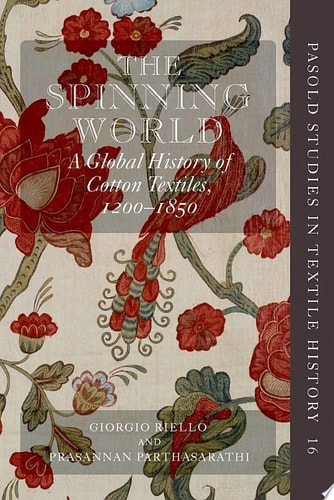
The Spinning World: A Global History of Cotton Textiles, 1200-1850
0
0
As an Amazon Associate and affiliate partner, Menrva Books earns from qualifying purchases. Learn more
Author Description
Cotton textiles were the first good to achieve a truly global reach. For many centuries muslins and calicoes from the Indian subcontinent were demanded in the trading worlds of the Indian Ocean and the eastern Mediterranean. After 1500, new circuits of exchange were developed. Of these, the early-modern European craze for Indian calicoes and the huge nineteenth-century export trade in Lancashire goods, and subsequent deindustrialization of the Indian subcontinent, are merely the best known. These episodes, although of great importance, far from exhaust the story of cotton. They are well known because of the enormous research energy that has been devoted to them, but other important elements of cotton's long history are deserving of similar attention.The purpose of this collection of essays is to examine the history of cotton textiles at a global level over the period 1200-1850. This volume sheds light on new answers to two questions: what is it about cotton that made it the paradigmatic first global commodity? And second, why did cotton industries in different parts of the world follow different paths of development?Essays included in the volume are authored by 19 scholars from eight different nations, all of whom are specialists in the study of textiles. They are drawn from a range of sub-disciplines within history and bring together their areas and periods of specialization to provide a global history. Therefore, the volume covers a wide variety of approaches to the study of history, which is essential for constructing a global picture. Some of the contributors are internationally well known for their publications on the history of cotton, as well as other textiles in different world areas. The volume also draws upon the research of a number of younger scholars whose work will form the core of the future development of textile history as a global discipline.
Menrva's Summary
THE THESIS
This volume investigates the factors that established cotton as the first truly global commodity and explores why textile industries across different regions followed divergent developmental paths between 1200 and 1850. Edited by Giorgio Riello and Prasannan Parthasarathi, the collection synthesizes research from nineteen international scholars to move beyond the traditional focus on European industrialization. By examining diverse regional histories, the authors provide a comprehensive framework for understanding how cotton shaped global trade networks and local economies over six centuries.
THE SCOPE MAP
What You Will Find
- A comparative analysis of textile production and trade across the Indian subcontinent, the Indian Ocean, the Mediterranean, and Europe.
- Examination of the transition from early-modern calico trade to nineteenth-century industrial manufacturing.
- Scholarly essays utilizing primary archival sources, economic data, and material culture studies.
- Exploration of the socio-economic impacts of deindustrialization and global market integration.
THE AUTHORITY PERSPECTIVE
Experts recognize this collection as a foundational text for understanding the global history of textiles and the complexities of early-modern trade. Scholars frequently cite the volume for its multi-disciplinary approach and its success in integrating regional histories into a cohesive global narrative.
Page Count:
489
Publication Date:
2011-11-14
Publisher:
OUP/Pasold Research Fund
ISBN-10:
0199696160
ISBN-13:
9780199696161
History
Industrial history
Global History
Economic History
Community Tags
Other Editions(2)
Similar Books




Reader Comments
Share Your Thoughts
No comments yet. Be the first to share your thoughts!