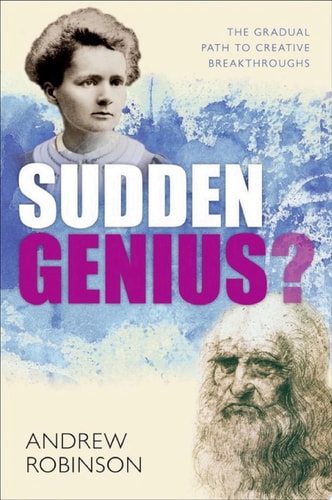
Sudden Genius?: The Gradual Path to Creative Breakthroughs
0
0
As an Amazon Associate and affiliate partner, Menrva Books earns from qualifying purchases. Learn more
Author Description
The highly admired scientist Linus Pauling, a double Nobel laureate in chemistry and peace, was once asked by a student. 'Dr Pauling, how do you have so many good ideas?' Pauling thought for a moment and replied: 'Well, David, I have a lot of ideas and throw away the bad ones.' Where do ideas come from? Why do some people have many more of them than others? How do you distinguish the good ideas from the bad? Most intriguing of all, perhaps, why do the best ideas sometimes strike in a flash of 'sudden genius'? These questions are the subject of this book. Andrew Robinson explores the exceptional creativity in both scientists and artists by following the trail that led ten individuals from childhood to the achievement of a famous creative breakthrough as an adult, in archaeology, architecture, art, biology, chemistry, cinema, music, literature, photography, and physics. Broken into three parts, the book begins with the scientific study of creativity, covering talent, genius, intelligence, memory, dreams, the unconscious, savant syndrome, synaesthesia, and mental illness. The second part tells the stories of five breakthroughs by scientists and five by artists, ranging from Curie's discovery of radium and Einstein's theory of special relativity to Mozart's composing of The Marriage of Figaro and Virginia Woolf's writing of Mrs Dalloway. Robinson concludes by considering what highly creative people who achieve breakthroughs have in common; whether breakthroughs in science and art follow patterns; and whether they always involve imaginative leaps and even 'genius'.
Menrva's Summary
THE THESIS
This book investigates the origins of creative breakthroughs and the validity of the 'sudden genius' phenomenon in both scientific and artistic fields. Andrew Robinson, a journalist and author specializing in science and history, synthesizes psychological research with biographical case studies to examine the cognitive processes behind innovation. He argues that what appears to be a spontaneous flash of insight is often the culmination of long-term preparation, persistence, and the systematic filtering of ideas.
THE SCOPE MAP
What You Will Find
- Scientific analysis of cognitive factors including memory, the unconscious, and synaesthesia
- Biographical case studies of ten figures including Marie Curie, Albert Einstein, Wolfgang Amadeus Mozart, and Virginia Woolf
- Comparative analysis between scientific discovery and artistic creation
Scope Limits
- The text does not provide a universal formula for achieving personal creative breakthroughs
- It does not focus on modern digital-age creativity or corporate innovation strategies
THE AUTHORITY PERSPECTIVE
Critics and readers frequently note the accessible yet rigorous approach Robinson takes in demystifying the concept of genius. Experts highlight this as a balanced text that successfully bridges the gap between psychological theory and historical narrative for the general reader.
Page Count:
408
Publication Date:
2010-01-01
Publisher:
OUP Oxford
ISBN-10:
0191624926
ISBN-13:
9780191624926
Non-Fiction
History
Psychology
Science
Biography
Creativity
Earth Sciences
Community Tags
Similar Books