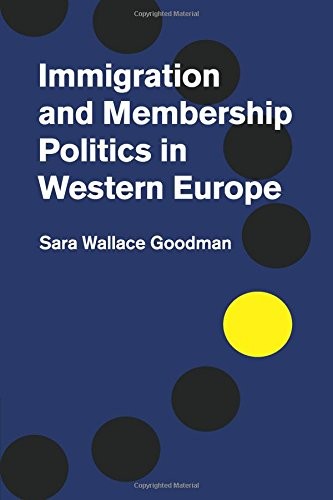
Immigration and Membership Politics in Western Europe
0
0
As an Amazon Associate and affiliate partner, Menrva Books earns from qualifying purchases. Learn more
Author Description
Why are traditional nation-states newly defining membership and belonging? In the twenty-first century, several Western European states have attached obligatory civic-integration requirements as conditions for citizenship and residence, which include promoting language proficiency, country knowledge, and value commitments for immigrants. This book examines civic-integration-policy adoption and adaptation through both medium-N analysis and three paired comparisons to argue that while there is convergence in instruments, there is also significant divergence in policy purpose, design, and outcomes
Menrva's Summary
THE THESIS
This book investigates why Western European nation-states are increasingly redefining the terms of membership and belonging in the twenty-first century. It examines the adoption and adaptation of civic-integration policies, which often impose obligatory requirements such as language proficiency, knowledge of the country, and commitment to its values for immigrants seeking citizenship and residence. Through a medium-N analysis and three paired comparisons, the study argues that while there is a convergence in the instruments used for these policies, significant divergence exists in their underlying purposes, designs, and ultimate outcomes.
THE SCOPE MAP
- Analysis of civic-integration policy adoption across Western Europe.
- Medium-N statistical analysis of policy trends.
- Three paired comparative case studies of specific countries.
- Examination of policy purpose, design, and outcomes.
- Focus on language proficiency, country knowledge, and value commitments as integration requirements.
- Exploration of convergence and divergence in policy instruments and objectives.
THE AUTHORITY PERSPECTIVE
The book examines the trend of Western European states imposing civic-integration requirements for citizenship and residence. It analyzes policy adoption and adaptation through statistical methods and comparative case studies, arguing for divergence in policy purpose despite instrumental convergence. The work is positioned as an academic inquiry into the evolving nature of national membership and belonging in contemporary Europe.
Page Count:
284
Publication Date:
2017-01-01
ISBN-10:
1107635853
ISBN-13:
9781107635852
Non-Fiction
Politics
Science
Citizenship
Immigration Policy
Sociology
Community Tags
Other Editions(4)


Similar Books