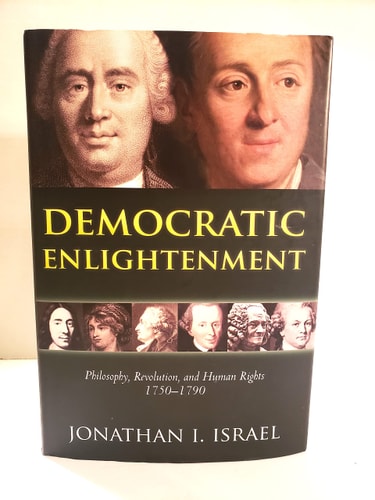
Democratic Enlightenment: Philosophy, Revolution, and Human Rights 1750-1790
0
0
As an Amazon Associate and affiliate partner, Menrva Books earns from qualifying purchases. Learn more
Author Description
That the Enlightenment shaped modernity is uncontested. Yet remarkably few historians or philosophers have attempted to trace the process of ideas from the political and social turmoil of the late eighteenth century to the present day. This is precisely what Jonathan Israel now does.In Democratic Enlightenment, Israel demonstrates that the Enlightenment was an essentially revolutionary process, driven by philosophical debate. The American Revolution and its concerns certainly acted as a major factor in the intellectual ferment that shaped the wider upheaval that followed, but the radical philosophes were no less critical than enthusiastic about the American model. From 1789, the General Revolution's impetus came from a small group of philosophe-revolutionnaires, men such as Mirabeau, Sieyes, Condorcet, Volney, Roederer, and Brissot. Not aligned to any of the social groups represented in the French National assembly, they nonetheless forged "la philosophie moderne"--in effect Radical Enlightenment ideas--into a world-transforming ideology that had a lasting impact in Latin America, Canada and eastern Europe as well as France, Italy, Germany, and the Low Countries. In addition, Israel argues that while all French revolutionary journals powerfully affirmed that la philosophie moderne was the main cause of the French Revolution, the main stream of historical thought has failed to grasp what this implies. Israel sets the record straight, demonstrating the true nature of the engine that drove the Revolution, and the intimate links between the radical wing of the Enlightenment and the anti-Robespierriste "Revolution of reason."Acclaim for earlier volumes in the trilogy:"His vast--and vastly impressive--book sets out to redefine the intellectual landscape of early modern Europe. Magnificent and magisterialwill undoubtedly be one of the truly great historical works of the decade." -- Sunday Telegraph"The scholarship is breathtaking. Israel has read everything, absorbed every nuance, followed up every byway." -- New Statesman"An enormously impressive piece of scholarship. The breadth and depth of the author's reading are breathtaking and Enlightenment Contested is set to become the definitive work for philosophers as well as historians on this extraordinary period." -- Tribune
Menrva's Summary
THE THESIS
This work investigates the core question of how radical Enlightenment philosophy functioned as the primary engine for the political and social revolutions of the late eighteenth century. Professor Jonathan I. Israel, a preeminent historian of the early modern period, utilizes an extensive analysis of primary source documents, revolutionary journals, and philosophical treatises to challenge traditional historiography. He argues that the French Revolution was not merely a product of social or economic forces, but was instead driven by a specific, coherent ideology forged by a group of radical philosophes who sought to transform the global political landscape.
THE SCOPE MAP
What You Will Find
- A detailed examination of the intellectual history of the Enlightenment between 1750 and 1790.
- An analysis of the influence of radical philosophy on the American and French Revolutions.
- Primary source evidence derived from the writings of figures such as Mirabeau, Sieyes, Condorcet, and Brissot.
- A comparative study of how radical Enlightenment ideas spread across Europe, Latin America, and Canada.
THE AUTHORITY PERSPECTIVE
Scholars and historians frequently note the immense academic density and exhaustive research present in this volume. It is widely regarded as a foundational text for understanding the intellectual origins of modern democratic thought and the specific philosophical currents that fueled revolutionary change.
Page Count:
1066
Publication Date:
2011-09-25
Publisher:
Oxford University Press
ISBN-10:
019954820X
ISBN-13:
9780199548200
Philosophy
History
Enlightenment
Philosophy history
Intellectual History
European History
Community Tags
Similar Books


Reader Comments
Share Your Thoughts
No comments yet. Be the first to share your thoughts!