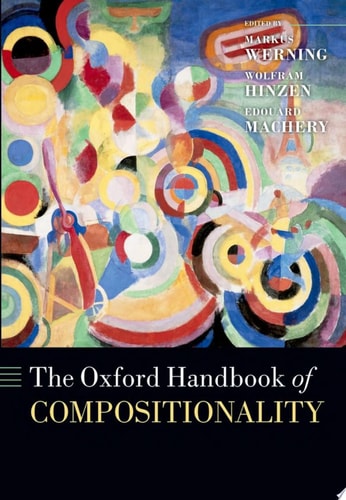
The Oxford Handbook of Compositionality
0
0
As an Amazon Associate and affiliate partner, Menrva Books earns from qualifying purchases. Learn more
Author Description
In This Book Leading Scholars From Every Relevant Field Report On All Aspects Of Compositionality, The Notion That The Meaning Of An Expression Can Be Derived From Its Parts. Understanding How Compositionality Works Is A Central Element Of Syntactic And Semantic Analysis And A Challenge For Models Of Cognition. It Is A Key Concept In Linguistics And Philosophy And In The Cognitive Sciences More Generally, And Is Without Question One Of The Most Exciting Fields In The Study Of Language And Mind. The Authors Of This Book Report Critically On Lines Of Research In Different Disciplines, Revealing The Connections Between Them And Highlighting Current Problems And Opportunities. The Force And Justification Of Compositionality Have Long Been Contentious. First Proposed By Frege As The Notion That The Meaning Of An Expression Is Generally Determined By The Meaning And Syntax Of Its Components, It Has Since Been Deployed As A Constraint On The Relation Between Theories Of Syntax And Semantics, As A Means Of Analysis, And More Recently As Underlying The Structures Of Representational Systems, Such As Computer Programs And Neural Architectures. The Oxford Handbook Of Compositionality Explores These And Many Other Dimensions Of This Challenging Field. It Will Appeal To Researchers And Advanced Students In Linguistics And Philosophy And To Everyone Concerned With The Study Of Language And Cognition Including Those Working In Neuroscience, Computational Science, And Bio-informatics.
Menrva's Summary
THE THESIS
This volume investigates the foundational principle of compositionality, which posits that the meaning of a complex expression is derived from the meanings of its constituent parts and their syntactic arrangement. Edited by Edouard Machery, Markus Werning, and Wolfram Hinzen, the handbook compiles contributions from leading scholars across linguistics, philosophy, and cognitive science. The text evaluates the historical development of the concept, tracing its origins from Frege to its modern applications in computational modeling and neural architecture.
THE SCOPE MAP
What You Will Find
- Historical analysis of Fregean compositionality and its evolution.
- Interdisciplinary perspectives on syntactic and semantic constraints.
- Applications of compositionality in computer programming and neural network design.
- Critical reviews of current research problems and theoretical opportunities.
Scope Limits
- The text does not provide introductory material for lay readers unfamiliar with formal logic or linguistics.
- It does not offer a singular, unified theory of compositionality, but rather a survey of competing academic viewpoints.
THE AUTHORITY PERSPECTIVE
Experts recognize this handbook as a comprehensive reference for researchers and advanced students navigating the intersection of language and mind. Readers frequently note the academic density of the prose, which requires a strong background in formal semantics or philosophy of language to fully synthesize the arguments presented.
Page Count:
0
Publication Date:
2012-01-01
Publisher:
Oxford University Press
ISBN-10:
0191633291
ISBN-13:
9780191633294
Philosophy
Reference
Linguistics
Syntax
Semantics
Community Tags
Other Editions(3)
Similar Books




Reader Comments
Share Your Thoughts
No comments yet. Be the first to share your thoughts!