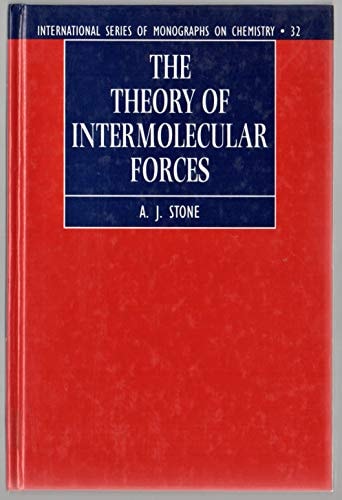
The Theory of Intermolecular Forces
0
0
As an Amazon Associate and affiliate partner, Menrva Books earns from qualifying purchases. Learn more
Author Description
The theory of intermolecular forces has advanced very greatly in recent years. It has become possible to carry out accurate calculations of intermolecular forces for molecules of useful size, and to apply the results to important practical applications such as understanding protein structure and function, and predicting the structures of molecular crystals. The Theory of Intermolecular Forces sets out the mathematical techniques that are needed to describe and calculate intermolecular interactions and to handle the more elaborate mathematical models. It describes the methods that are used to calculate them, including recent developments in the use of density functional theory and symmetry-adapted perturbation theory. The use of higher-rank multipole moments to describe electrostatic interactions is explained in both Cartesian and spherical tensor formalism, and methods that avoid the multipole expansion are also discussed. Modern ab initio perturbation theory methods for the calculation of intermolecular interactions are discussed in detail, and methods for calculating properties of molecular clusters and condensed matter for comparison with experiment are surveyed.
Menrva's Summary
THE THESIS
This text investigates the mathematical and theoretical frameworks required to calculate and describe intermolecular forces in complex molecular systems. Anthony Stone, a recognized authority in theoretical chemistry, synthesizes advanced computational methods to bridge the gap between fundamental quantum mechanical principles and practical applications in molecular science. The book provides a rigorous examination of how modern ab initio techniques and perturbation theories allow for the accurate prediction of molecular behavior in various states of matter.
THE SCOPE MAP
What You Will Find
- Mathematical techniques for calculating intermolecular interactions
- Density functional theory and symmetry-adapted perturbation theory applications
- Electrostatic interaction modeling using Cartesian and spherical tensor formalism
- Analysis of molecular clusters and condensed matter properties
Scope Limits
- Does not provide a general introduction to basic chemistry for non-specialists
- Excludes experimental laboratory protocols, focusing instead on theoretical and computational derivation
THE AUTHORITY PERSPECTIVE
Experts and researchers in the field of physical chemistry frequently cite this work as a foundational reference for understanding the transition from simple models to advanced ab initio calculations. Readers often note the high level of mathematical density, making it a specialized resource intended for graduate-level students and professional computational chemists.
Page Count:
352
Publication Date:
2013-01-01
Publisher:
OUP Oxford
ISBN-10:
0191652954
ISBN-13:
9780191652950
Science
Physical Chemistry
Molecular Physics
Physics
Earth Sciences
Chemistry
Chemical bonds
Community Tags
Other Editions(3)

Similar Books