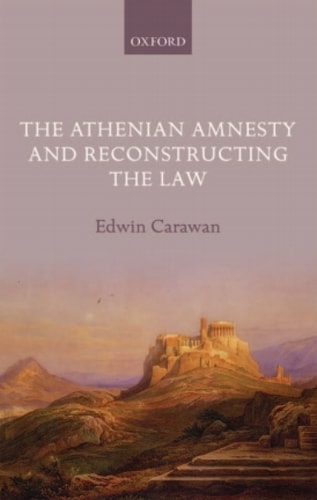
The Athenian Amnesty and Reconstructing the Law
0
0
As an Amazon Associate and affiliate partner, Menrva Books earns from qualifying purchases. Learn more
Author Description
This volume explores the amnesty which ended the civil war at Athens in 403 BC. Drawing upon ancient historians and speechwriters, together with the surviving inscriptions, it presents a new interpretation of the Athenian Amnesty in its original setting and in view of the subsequent reconstruction of laws and democratic institutions in Athens. Beginning with the evidence on the original agreement and the events that shaped it, the volume also discusses the major trials that challenged and reinterpreted key elements of the amnesty agreement, including the trial of Socrates. These studies reveal the Athenian Amnesty as a contractual settlement between the warring parties, a bargain for peace and reconciliation. The oath that came to symbolize the Amnesty was the closing to that contract, a pledge not to go back on the covenants that spelled out remedies and restrictions-not a promise to forgive and forget. The same contractual principle inspired major reforms of the restored democracy, barring litigation on settled claims and ensuring that new legislation did not conflict with the constitution. While this book deals largely with the ancient agreement, Carawan also draws perspectives from parallels in modern history, such as the post-apartheid settlement in South Africa, illustrating how the Athenian Amnesty is generally regarded as the model for political 'forgiveness' or 'pardon and oblivion' embraced in later conflict resolution.
Menrva's Summary
THE THESIS
This volume investigates the historical function and legal implications of the Athenian Amnesty of 403 BC, challenging the traditional view of the agreement as a simple act of forgiveness. Edwin Carawan, a scholar of classical law and rhetoric, utilizes a synthesis of ancient historical accounts, oratorical texts, and epigraphic evidence to reframe the amnesty as a calculated contractual settlement. The work argues that the agreement served as a functional mechanism for political stabilization and institutional reconstruction rather than a moral mandate for reconciliation.
THE SCOPE MAP
What You Will Find
- Analysis of the 403 BC Athenian civil war settlement
- Examination of the trial of Socrates in the context of amnesty violations
- Comparative study of ancient political settlements and modern conflict resolution models
- Review of legislative reforms regarding litigation and constitutional integrity
Scope Limits
- The text focuses primarily on the legal and political mechanics of the Athenian state
- It does not provide a comprehensive military history of the Peloponnesian War
THE AUTHORITY PERSPECTIVE
Scholars and historians recognize this work as a rigorous examination of Athenian legal history that effectively bridges the gap between ancient practice and modern political theory. Readers frequently note the academic density of the prose, which is tailored for those with a background in classical studies or legal history.
Page Count:
320
Publication Date:
2013-01-01
Publisher:
OUP Oxford
ISBN-10:
019165339X
ISBN-13:
9780191653391
History
Ancient Greece
Ancient History
Amnesty
Conflict Resolution
Athens Greece
Law