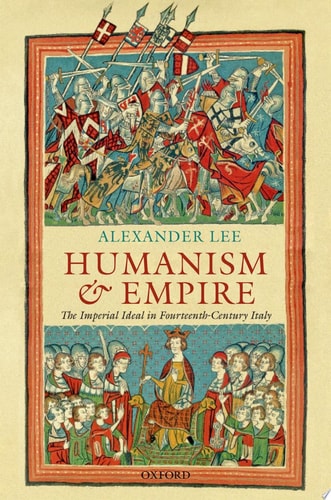
Humanism and Empire: The Imperial Ideal in Fourteenth-Century Italy
0
0
As an Amazon Associate and affiliate partner, Menrva Books earns from qualifying purchases. Learn more
Author Description
For more than a century, scholars have believed that Italian humanism was predominantly civic in outlook. Often serving in communal government, fourteenth-century humanists like Albertino Mussato and Coluccio Saltuati are said to have derived from their reading of the Latin classics a rhetoric of republican liberty that was opposed to the 'tyranny' of neighbouring signori and of the German emperors. In this ground-breaking study, Alexander Lee challenges this long-held belief. From the death of Frederick II in 1250 to the failure of Rupert of the Palatinate's ill-fated expedition in 1402, Lee argues, the humanists nurtured a consistent and powerful affection for the Holy Roman Empire. Though this was articulated in a variety of different ways, it was nevertheless driven more by political conviction than by cultural concerns. Surrounded by endless conflict - both within and between city-states - the humanists eagerly embraced the Empire as the surest guarantee of peace and liberty, and lost no opportunity to invoke its protection. Indeed, as Lee shows, the most ardent appeals to imperial authority were made not by 'signorial' humanists, but by humanists in the service of communal regimes. The first comprehensive, synoptic study of humanistic ideas of Empire in the period c.1250-1402, this volume offers a radically new interpretation of fourteenth-century political thought, and raises wide-ranging questions about the foundations of modern constitutional ideas. As such, it is essential reading not just for students of Renaissance Italy and the history of political thought, but for all those interested in understanding the origins of liberty
Menrva's Summary
THE THESIS
This book investigates the historical misconception that fourteenth-century Italian humanism was primarily defined by a commitment to republican liberty and opposition to imperial authority. Alexander Lee, a scholar of Renaissance history, utilizes a broad range of primary sources and political treatises from the period between 1250 and 1402 to challenge the prevailing civic-humanist narrative. He argues that humanists consistently advocated for the Holy Roman Empire as a necessary mechanism for maintaining peace and stability amidst the endemic conflicts of the Italian city-states.
THE SCOPE MAP
What You Will Find
- An analysis of political thought from the death of Frederick II in 1250 to the expedition of Rupert of the Palatinate in 1402.
- A re-evaluation of the political allegiances of figures such as Albertino Mussato and Coluccio Salutati.
- A comparative study of imperial rhetoric across both communal and signorial regimes.
Scope Limits
- The study focuses specifically on the fourteenth-century context and does not extend into the later developments of the High Renaissance.
- The analysis is restricted to the intersection of humanism and imperial ideology, excluding broader social or economic history of the period.
THE AUTHORITY PERSPECTIVE
Experts recognize this work as a significant revisionist study that forces a re-examination of the foundations of modern constitutional thought. Readers frequently note the academic density of the prose, which is intended for specialists in political history and Renaissance studies.
Page Count:
464
Publication Date:
2018-01-01
Publisher:
OUP Oxford
ISBN-10:
019166264X
ISBN-13:
9780191662645
History
Italian History
Politics & Government
European History
Humanism
Political Philosophy
Community Tags
Similar Books