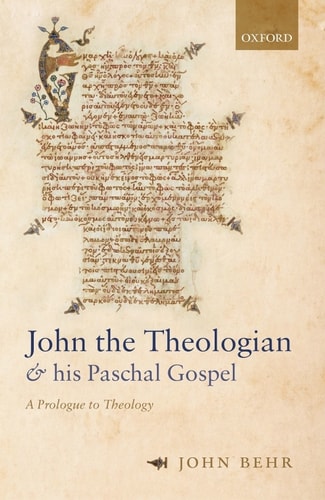
John the Theologian and His Paschal Gospel: A Prologue to Theology
0
0
As an Amazon Associate and affiliate partner, Menrva Books earns from qualifying purchases. Learn more
Author Description
John the theologian and his Paschal Gospel brings three different kinds of readers of the Gospel of John together with the theological goal of understanding what is meant by Incarnation and how it relates to Pascha, the Passion of Christ, how this is conceived of as revelation, and how we speak of it. The first group of readers are the Christian writers from the early centuries, some of whom (such as Irenaeus of Lyons) stood in direct continuity, through Polycarp of Smyrna, with John himself. In exploring these writers, John Behr offers a glimpse of the figure of John and the celebration of Pascha, which is held to have started with him. The second group of readers are modern scriptural scholars, from whom we learn of the apocalyptic dimensions of John's Gospel and the way in which it presents the life of Christ in terms of the Temple and its feasts. Christ's own body, finally erected on the cross, is seen as the true Temple in an offering of love rather than a sacrifice for sin--an offering in which Jesus becomes the flesh he offers for consumption, the bread which descends from heaven, so that 'Incarnation' is not an event now in the past, but the embodiment of God in those who follow Christ in the present. The third reader is Michel Henry, a French phenomenologist, whose reading of John opens up further surprising dimensions of this Gospel, which yet align with those uncovered in the first parts of this work. This thought-provoking work brings these threads together to reflect on the nature and task of Christian theology.
Menrva's Summary
THE THESIS
This work investigates the theological relationship between the Incarnation and Pascha, arguing that the Gospel of John presents Christ's crucifixion not as a sacrifice for sin, but as the manifestation of the true Temple through an offering of love. John Behr, a prominent patristic scholar and theologian, synthesizes historical, scriptural, and phenomenological perspectives to reframe the understanding of revelation. By bridging early Christian tradition with modern scholarship and contemporary philosophy, Behr proposes a model of theology that views the Incarnation as an ongoing embodiment of God within the life of the believer.
THE SCOPE MAP
What You Will Find
- Analysis of early Christian writers including Irenaeus of Lyons and Polycarp of Smyrna.
- Examination of the apocalyptic dimensions of the Gospel of John and its connection to Temple theology.
- Integration of Michel Henry’s phenomenological reading of the Gospel.
- A reinterpretation of the Eucharist and the bread of life as the embodiment of the Word.
Scope Limits
- The text does not provide a comprehensive verse-by-verse commentary on the entire Gospel of John.
- It does not engage extensively with secular historical-critical methodologies that reject the theological unity of the text.
THE AUTHORITY PERSPECTIVE
Scholars and theologians frequently note the high level of academic density and the sophisticated synthesis of patristic and phenomenological thought present in Behr's prose. Experts highlight this as a significant contribution to contemporary Johannine studies, particularly for those interested in the intersection of ancient tradition and modern philosophical inquiry.
Page Count:
388
Publication Date:
1900-01-01
Publisher:
Oxford University Press
ISBN-10:
0191874175
ISBN-13:
9780191874178
Christian Theology
Philosophy of
Patristics