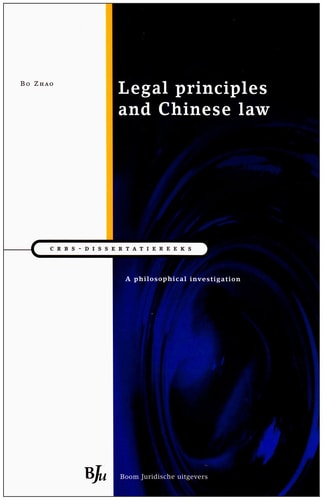
Legal Principles and Chinese Law: A Philosophical Investigation
0
0
As an Amazon Associate and affiliate partner, Menrva Books earns from qualifying purchases. Learn more
Author Description
This book offers an unorthodox account of the concept of "legal principle" - perhaps the most controversial concept in legal scholarship - by combining western legal theory and Chinese legal practice. The unbalanced development of the present Chinese society that has led to many social problems frames the debates in the book. The author argues that a possible effective legal resolution can be found in an emphasis on legal principles. The author probes at the different functions of rules and principles in legal development. He shows how principles, together with rules, play a significant role in securing the interests of a society in the long run. The author postulates that principles represent the fundamental goals and values of a legal system that has a long term nature. In contrast, policies focus more on short term goals and ends. The book further explores the two contradicting characteristics of principles - a hard characteristic prescribing certain bottom lines to be secured, and a soft characteristic driving to optimize desired goals and values. Given these contrasting characteristics, the relationship between rules and principles and between policies and principles is redefined accordingly so rules, principles and policies are not contradictory but complementary. Applying the analysis to recent Chinese law developments, the author concludes that the current transitional period of development lacks solid legal principles through which China's future interests can be protected and upheld.The short term approach from inconsistent policies - legal or political, which are pervasive in the present Chinese society - restricts the much needed long term legal protection and undoubtedly endangers China's sustainable development.
Menrva's Summary
THE THESIS
This book investigates the controversial concept of "legal principle" by integrating Western legal theory with Chinese legal practice. The author, Bo Zhao, addresses the social problems arising from China's unbalanced development, arguing that a stronger emphasis on legal principles can offer effective resolutions. The work distinguishes between the long-term societal interests secured by principles and the short-term goals of policies, exploring the dual nature of principles as both prescriptive and optimizing. Zhao redefines the relationships between rules, principles, and policies, positing them as complementary rather than contradictory.
THE SCOPE MAP
- Analysis of the concept of "legal principle" in legal scholarship.
- Integration of Western legal theory and Chinese legal practice.
- Examination of social problems stemming from China's unbalanced development.
- Argument for the efficacy of legal principles in resolving societal issues.
- Distinction between the functions of rules and principles in legal development.
- Exploration of the long-term nature of principles versus short-term policies.
- Discussion of the dual characteristics of principles: prescriptive bottom lines and optimizing goals.
- Application of the analysis to recent developments in Chinese law.
THE AUTHORITY PERSPECTIVE
The book is characterized by its ambitious attempt to bridge Western legal theory with the realities of Chinese legal practice, focusing on the critical concept of legal principles. The author's argument centers on the idea that a robust understanding and application of these principles are essential for China's sustainable development, particularly in addressing issues arising from rapid societal change. The work is likely to appeal to scholars and practitioners interested in comparative law, legal philosophy, and the specific challenges facing contemporary China. The analysis of principles as complementary to rules and policies offers a nuanced perspective on legal system design.
Page Count:
185
Publication Date:
2009-01-01
Publisher:
Boom Juridische uitgevers
ISBN-10:
9089741003
ISBN-13:
9789089741004
Philosophy
Non-Fiction
Chinese Law
Legal Theory
Community Tags
Similar Books