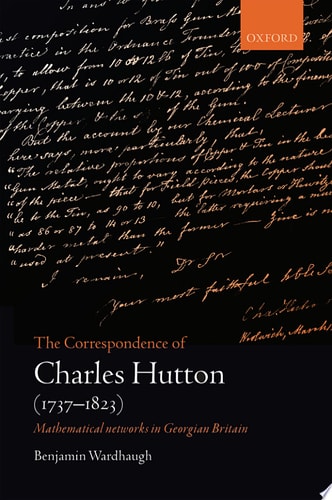
The Correspondence of Charles Hutton
0
0
As an Amazon Associate and affiliate partner, Menrva Books earns from qualifying purchases. Learn more
Author Description
This Book Contains All The Letters That Are Known To Survive From The Correspondence Of Charles Hutton (1737-1823). Hutton Was One Of The Most Prominent British Mathematicians Of His Generation; He Played Roles At The Royal Society, The Royal Military Academy, The Board Of Longitude, The 'philomath' Network And Elsewhere. He Worked On The Explosive Force Of Gunpowder And The Mean Density Of The Earth, Wining The Royal Society's Copley Medal In 1778; He Was Also At The Focus Of A Celebrated Row At The Royal Society In 1784 Over The Place Of Mathematics There. He Is Of Particular Historical Interest Because Of The Variety Of Roles He Played In British Mathematics, The Dexterity With Which He Navigated, Exploited And Shaped Personal And Professional Networks In Mathematics And Science, And The Length And Visibility Of His Career. Hutton Corresponded Nationally And Internationally, And His Correspondence Illustrates The Overlapping, The Intersection And Interaction Of The Different Networks In Which Hutton Moved. It Therefore Provides New Information About How Georgian Mathematics Was Structured Socially, And How Mathematical Careers Worked In That Period. It Provides A Rare And Valuable View Of A Mathematical Culture That Would Substantially Cease To Exist When British Mathematics Embraced Continental Methods From The Early Ninetheenth Century Onwards. Over 130 Letters Survive, From 1770 To 1822, But They Are Widely Scattered (in Nearly Thirty Different Archives) And Have Not Been Catalogued Or Edited Before. This Edition Situates The Correspondence With An Introduction And Explanatory Notes.
Menrva's Summary
THE THESIS
This collection investigates the social and professional structures of Georgian-era mathematics through the surviving correspondence of Charles Hutton. Benjamin Wardhaugh, a historian of mathematics, compiles and annotates over 130 letters to reconstruct the career of a central figure in 18th-century British science. By analyzing Hutton's interactions within the Royal Society and the Board of Longitude, the work argues that personal networks were the primary mechanism for career advancement and scientific exchange during this period.
THE SCOPE MAP
What You Will Find
- A comprehensive collection of over 130 letters spanning 1770 to 1822.
- Documentation of Hutton's involvement in the Royal Society, the Royal Military Academy, and the 'philomath' network.
- Detailed editorial notes and an introduction contextualizing the letters within the broader history of British science.
Scope Limits
- The collection is limited to surviving letters and does not account for lost correspondence.
- The analysis focuses primarily on the social and professional network of Hutton rather than providing a technical deep-dive into his mathematical proofs.
THE AUTHORITY PERSPECTIVE
Historians of science view this volume as a critical primary source for understanding the social dynamics of 18th-century British mathematics. Scholars frequently note that the meticulous editing and contextualization make it a foundational text for researchers studying the transition toward modern scientific institutions.
Page Count:
304
Publication Date:
2017-01-01
Publisher:
Oxford University Press
ISBN-10:
0192527223
ISBN-13:
9780192527226
Biography
Science History
Mathematics
Academic History
Georgian Era
Correspondence
Community Tags
Similar Books