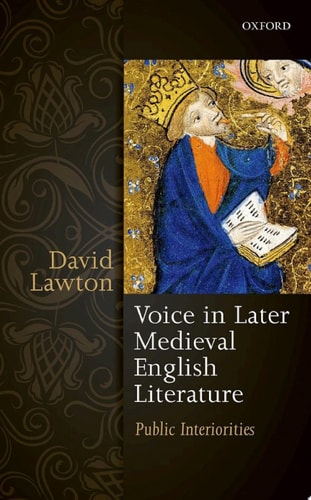
Voice in Later Medieval English Literature: Public Interiorities
0
0
As an Amazon Associate and affiliate partner, Menrva Books earns from qualifying purchases. Learn more
Author Description
David Lawton approaches later medieval English vernacular culture in terms of voice. As texts and discourses shift in translation and in use from one language to another, antecedent texts are revoiced in ways that recreate them (as 'public interiorities') without effacing their history or future. The approach yields important insights into the voice work of late medieval poets, especially Langland and Chaucer, and also their fifteenth-century successors, who treat their work as they have treated their precursors. It also helps illuminate vernacular religious writing and its aspirations, and it addresses literary and cultural change, such as the effect of censorship and increasing political instability in and beyond the fifteenth century. Lawton also proposes his emphasis on voice as a literary tool of broad application, and his book has a bold and comparative sweep that encompasses the Pauline letters, Augustine's Confessions, the classical precedents of Virgil and Ovid, medieval contemporaries like Machaut and Petrarch, extra-literary artists like Monteverdi, later poets such as Wordsworth, Heaney and Paul Valéry, and moderns such as Jarry and Proust. What justifies such parallels, the author claims, is that late medieval texts constitute the foundation of a literary history of voice that extends to modernity. The book's energy is therefore devoted to the transformative reading of later medieval texts, in order to show their original and ongoing importance as voice work.
Menrva's Summary
THE THESIS
This work investigates the concept of voice as a foundational element of late medieval English vernacular culture, arguing that texts function as 'public interiorities' that bridge historical and modern literary practices. David Lawton, a scholar of medieval literature, utilizes a comparative framework to analyze how vernacular texts are revoiced through translation and usage. He posits that late medieval writers, particularly Langland and Chaucer, established a tradition of voice work that remains relevant through its influence on subsequent centuries of literary production.
THE SCOPE MAP
What You Will Find
- Analysis of late medieval English vernacular texts and their transformative revoicing.
- A comparative methodology linking medieval works to classical, early modern, and contemporary authors.
- Examination of the intersection between literary production, religious writing, and political instability.
Scope Limits
- The study does not provide a comprehensive history of all medieval literature, focusing instead on the specific mechanism of voice.
- It does not offer a linguistic analysis of Middle English dialects, prioritizing literary and cultural theory over philology.
THE AUTHORITY PERSPECTIVE
Scholars frequently note the ambitious scope of Lawton's comparative approach, which bridges disparate historical periods through the lens of voice. The text is recognized for its dense theoretical framework, making it a significant resource for advanced students and researchers of medieval literary history.
Page Count:
255
Publication Date:
2016-01-01
Publisher:
OUP Oxford
ISBN-10:
0192510851
ISBN-13:
9780192510853
English literature
Poetics
Cultural History
Literary Criticism
English & College Success
English