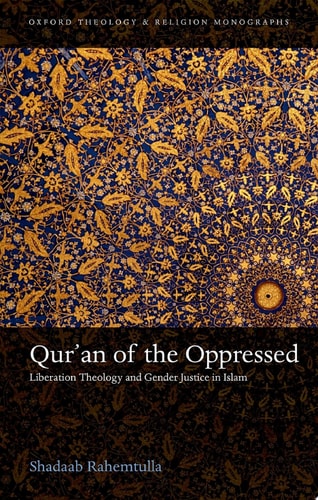
Qur'an of the Oppressed: Liberation Theology and Gender Justice in Islam
0
0
As an Amazon Associate and affiliate partner, Menrva Books earns from qualifying purchases. Learn more
Author Description
This study analyses the commentaries of four Muslim intellectuals who have turned to scripture as a liberating text to confront an array of problems, from patriarchy, racism, and empire to poverty and interreligious communal violence. Shadaab Rahemtulla considers the exegeses of the South African Farid Esack (b. 1956), the Indian Asghar Ali Engineer (1939-2013), the African American Amina Wadud (b. 1952), and the Pakistani American Asma Barlas (b. 1950). Rahemtulla examines how these intellectuals have been able to expound this seventh-century Arabian text in a socially liberating way, addressing their own lived realities of oppression, and thus contexts that are worlds removed from that of the text's immediate audience. Through a close reading of their works, he underlines the importance of both the ethico-social content of the Qur'an and their usage of new and innovative reading practices. This work provides a rich analysis of the thought-ways of specific Muslim intellectuals, thereby substantiating a broadly framed school of thought. Rahemtulla draws out their specific and general importance without displaying an uncritical sympathy. He sheds light on the impact of modern exegetical commentary which is more self-consciously concerned with historical context and present realities. In a mutually reinforcing way, this work thus illuminates both the role of agency and hermeneutical approaches in modern Islamic thought.
Menrva's Summary
THE THESIS
This book investigates how contemporary Muslim intellectuals utilize the Qur'an as a framework for liberation to address modern systemic injustices such as patriarchy, racism, and poverty. Shadaab Rahemtulla, an academic specializing in Islamic studies, examines the exegetical methodologies of four prominent thinkers: Farid Esack, Asghar Ali Engineer, Amina Wadud, and Asma Barlas. By analyzing their interpretive strategies, the author argues that these scholars successfully bridge the gap between seventh-century scripture and the urgent socio-political realities of the modern world.
THE SCOPE MAP
What You Will Find
- Comparative analysis of four major Muslim intellectuals and their specific hermeneutical approaches.
- Examination of the intersection between Islamic scripture and modern social justice movements.
- Discussion of the role of historical context in contemporary Qur'anic exegesis.
Scope Limits
- The study focuses specifically on the selected four intellectuals and does not provide an exhaustive survey of all modern Islamic liberation movements.
- The text prioritizes academic theological analysis over a general historical narrative of Islamic development.
THE AUTHORITY PERSPECTIVE
Scholars and students of Islamic theology frequently cite this work as a rigorous examination of modern hermeneutical shifts within the faith. Experts highlight the text's academic density and its contribution to understanding how religious tradition adapts to address contemporary human rights concerns.
Page Count:
307
Publication Date:
2017-01-01
Publisher:
OUP Oxford
ISBN-10:
0192516507
ISBN-13:
9780192516503
Religion
Social justice
Hermeneutics
Islam
Liberation theology
Theology
Islam And Politics
Gender Studies