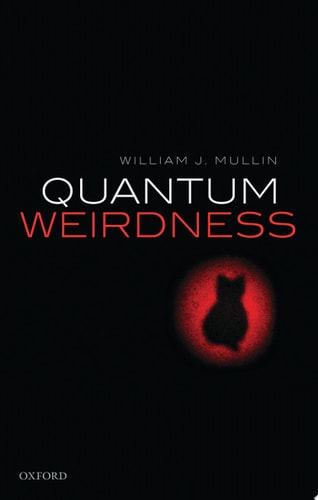
Quantum Weirdness
0
0
As an Amazon Associate and affiliate partner, Menrva Books earns from qualifying purchases. Learn more
Author Description
Quantum mechanics allows a remarkably accurate description of nature and powerful predictive capabilities. The analyses of quantum systems and their interpretation lead to many surprises, for example, the ability to detect the characteristics of an object without ever touching it in any way, via "interaction-free measurement," or the teleportation of an atomic state over large distances. The results can become downright bizarre. Quantum mechanics is a subtle subject that usually involves complicated mathematics — calculus, partial differential equations, etc., for complete understanding. Most texts for general audiences avoid all mathematics. The result is that the reader misses almost all deep understanding of the subject, much of which can be probed with just high-school level algebra and trigonometry. Thus, readers with that level of mathematics can learn so much more about this fundamental science. The book starts with a discussion of the basic physics of waves (an appendix reviews some necessary classical physics concepts) and then introduces the fundamentals of quantum mechanics, including the wave function, superposition, entanglement, Bell's theorem, etc., and applications to Bose—Einstein condensation, quantum computing, and much more. The interpretation of the mathematics of quantum mechanics into a world view has been the subject of much controversy. The result is a variety of conflicting interpretations, from the famous Copenhagen view of Bohr to the multiple universes of Everett. We discuss these interpretations in the chapter "What is a wave function?" and include some very recent advances, for example, quantum Bayesianism, and measurements of the reality of the wave function.
Menrva's Summary
THE THESIS
This book investigates whether a deeper, mathematically grounded understanding of quantum mechanics is accessible to readers possessing only high-school level algebra and trigonometry. Author William J. Mullin, a physicist, argues that general-audience texts often oversimplify quantum mechanics by omitting necessary mathematics. He presents a framework that bridges the gap between popular science narratives and advanced academic textbooks, utilizing algebra and trigonometry to explain complex phenomena like entanglement and wave functions. The text aims to provide a rigorous yet approachable entry point for those interested in the fundamental science of the subatomic world.
THE SCOPE MAP
What You Will Find
- Fundamental physics of waves and classical physics concepts
- Core quantum mechanics topics including superposition, Bell's theorem, and the wave function
- Applications in Bose-Einstein condensation and quantum computing
- Comparative analysis of interpretations such as the Copenhagen view and quantum Bayesianism
Scope Limits
- Does not cover advanced quantum field theory or complex calculus-based derivations
- Does not provide a comprehensive history of physics beyond the context of specific quantum developments
THE AUTHORITY PERSPECTIVE
Experts and readers appreciate this work for its unique position as a bridge between overly simplistic popular science and dense academic literature. The text is frequently cited as a valuable resource for students and enthusiasts who want to engage with the actual mechanics of quantum theory without needing a graduate degree in physics.
Page Count:
224
Publication Date:
2017-01-01
Publisher:
OUP Oxford
ISBN-10:
0192514342
ISBN-13:
9780192514349
Science
Non-Fiction
Physics
Education
Earth Sciences
Community Tags
Other Editions(3)

Similar Books










Reader Comments
Share Your Thoughts
No comments yet. Be the first to share your thoughts!